PART 1
She Threw $300 at My Feet and Told Me to Pick It Up—Then Her Father Saw the Necklace Around My Neck
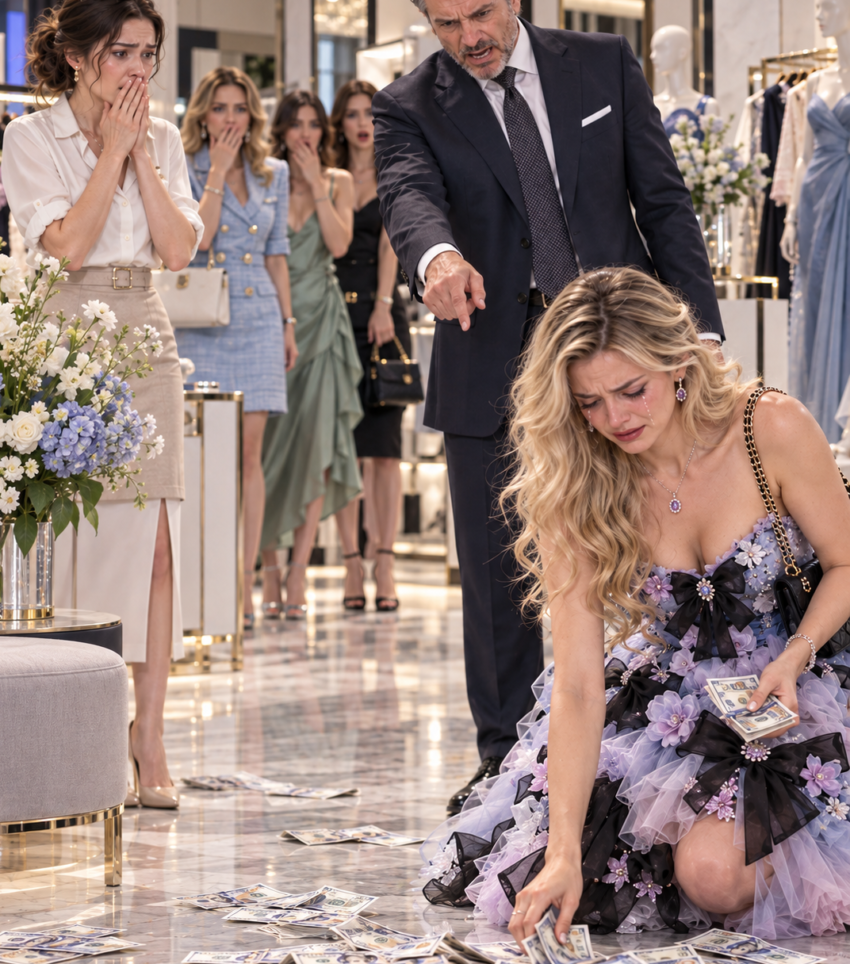
The woman standing across from my counter pulled three hundred-dollar bills from her purse and dropped them at my feet.
One landed beside my shoe. Another slid beneath a clothing rack.
“There. If three hundred dollars matters that much to you, pick it up.”
Four customers were watching us by then, but I didn’t bend down. I kept one hand on the red cocktail dress she’d brought back that morning, its hem streaked with dirt and a dark wine stain spreading across the waist.
“I’m not refusing the refund because I need your money,” I said. “I’m refusing because you wore the dress, removed the tag, stained it, and now I can’t sell it to somebody else as new.”
She rolled her eyes.
“I wore it for one dinner. You’re acting like I dragged it behind my car.”
“I offered you store credit.”
“I don’t want store credit.”
She leaned closer.
“Do you even know who I am?”
I didn’t.
Apparently that offended her more than the return policy.
“Renata Vale.”
The name registered. Vale Department Stores had locations all over Arizona and several neighboring states.
“Okay.”
She stared at me.
“Okay? That’s it?”
“I don’t know what you want me to say. My return policy doesn’t change because your last name is Vale.”
Her mouth tightened. She glanced toward the other customers and gave a short laugh.
“Honestly, I don’t know how little places like this stay open. Half the women shopping here probably have to check their bank accounts before buying a dress.”
A woman near the fitting rooms slowly lowered the blouse she’d been holding.
That bothered me more than anything Renata had said about me.
My mother had built Elena’s Closet from one rack of consignment dresses and a borrowed sewing machine. Four months after her death, I was twenty-six years old, grieving, behind on two supplier invoices, and doing everything possible to keep her store alive.
Those customers had kept us alive too.
I walked around the counter and placed the red dress in Renata’s arms.
“You need to leave.”
Her eyebrows lifted.
“You’re throwing me out?”
“I’m asking you to take your dress and stop insulting my customers.”
“You’re unbelievable.”
The bell above the door rang.
A man in a charcoal suit stepped inside.
Renata turned.
“Dad?”
He looked at her, then at me, then at the money scattered across the floor.
His expression changed.
“What’s going on?”
Renata sighed.
“Nothing. She’s refusing to refund a dress.”
He pointed toward the bills.
“What’s that?”
“Dad, please. Can we just go?”
His voice remained calm.
“Did you throw that money on the floor?”
Renata folded her arms.
“I was giving it to her.”
He looked at the bill beside my shoe.
“By throwing it at her feet?”
Renata didn’t answer.
Her father waited.
“Pick it up.”
Her face flushed.
“Seriously?”
“Yes. All of it.”
“You’re going to embarrass me in front of everyone?”
He glanced around the boutique.
“You seemed comfortable embarrassing her in front of everyone.”
Renata crouched, retrieved the bills, including the one beneath the rack, and shoved them back into her purse.
Her father nodded toward me.
“Now apologize.”
“Dad—”
“Renata.”
She stared at him before finally turning to me.
“I’m sorry. I shouldn’t have thrown the money, and I shouldn’t have said that about your customers.”
“Thank you.”
Renata grabbed the dress.
“Can we go now?”
Her father nodded toward the door.
“Wait outside. I’ll be there in a minute.”
She left without looking at me.
The man remained.
“I’m sorry,” he said. “She had no right to speak to you that way.”
“I appreciate that.”
I bent to straighten a display.
When I stood again, he wasn’t looking at the clothes.
He was staring at my necklace.
The Necklace My Mother Never Took Off
It was a small silver flower with a faded blue stone in the center.
Nothing expensive.
My mother had worn it for as long as I could remember. After she died, I found it in the ceramic dish beside her bed and started wearing it myself.
The man seemed to forget where he was.
“I’m sorry. Where did you get that?”
My fingers went instinctively to the pendant.
“It was my mother’s.”
“What was her name?”
I hesitated.
He noticed immediately.
“Sorry. That’s a strange question. I just… I’ve seen that necklace before.”
“Elena Salgado.”
The color left his face.
“Elena?”
“Yes.”
He reached slowly for his wallet.
“My name is Alexander Vale. I need to show you something.”
From behind his driver’s license, he removed an old photograph with softened corners.
He placed it on the counter.
My mother stood in the picture.
She couldn’t have been older than twenty-one. Her hair was long, her smile wide, and beside her stood a much younger Alexander Vale.
Around Mom’s neck was my silver flower.
I looked from the photograph to him.
“Why do you have a picture of my mother?”
Alexander pulled one of the chairs near the fitting rooms closer but waited before sitting.
“Elena and I were together when we were young.”
“Together how?”
He rubbed his thumb along the edge of the photograph.
“We planned to get married.”
I stared at him.
My mother had never mentioned Alexander Vale.
He explained that he had worked for my grandfather’s distribution company when he was barely out of college. My grandfather disliked him immediately—no money, no influential family, no future he considered suitable for Elena.
Then Alexander was offered a job in California.
“Your mother wanted me to take it,” he said. “We thought I’d work for a year, save money and come back.”
“But you didn’t.”
“I wrote constantly. At first she answered. Then her letters stopped, and mine started coming back unopened.”
Alexander returned to Arizona months later.
My grandfather told him Elena had married someone else and moved away.
“And you believed him?”
Alexander lowered his eyes.
“For longer than I should have.”
“She never married.”
His face tightened.
“I know that now.”
“She raised me alone.”
This time, when he looked at me, neither of us spoke.
Something in my stomach tightened.
Then I remembered the envelope.
The Letter Behind Her Sewing Machine
After Mom died, I had spent weeks sorting through the apartment above the boutique.
Behind her old sewing machine, wedged between the table and the wall, I’d found an envelope with one name written across the front.
Alexander.
No last name.
No address.
I had kept it because it was in Mom’s handwriting.
I went into the back room and returned with the envelope.
Alexander recognized the handwriting before I reached the counter.
“Where did you find that?”
“Behind her sewing machine.”
His hand stopped halfway toward it.
“May I?”
I handed him the letter.
As he read, his expression changed.
Then he went back to the beginning and read it again.
“She was pregnant.”
The boutique suddenly felt too quiet.
“What?”
He turned the page toward me.
Mom had written that her father wanted her to give up the baby. She had refused. She wrote that she didn’t understand why Alexander had stopped answering her and begged him to come back before her father found another way to separate them.
Alexander looked at me.
“When were you born?”
I told him.
His eyes dropped to the date on the letter.
I did the math at the same time he did.
“Sophie…”
“Don’t.”
He stopped immediately.
I folded my arms because I needed something to hold in place.
“We don’t know anything yet.”
“You’re right.”
“My mother told me my father knew she was pregnant and didn’t want me.”
Alexander’s face changed again.
“I swear to you, I never knew.”
I wanted to believe him.
That frightened me more than deciding he was lying.
Before either of us could say more, the bell above the door rang.
Renata walked back inside.
“Dad, are you coming? I’ve been sitting out there for—”
She saw the photograph.
Then the letter.
Then her father’s face.
“What’s going on?”
Alexander folded the letter carefully.
“I don’t know yet.”
99.99 Percent
Two independent DNA tests answered the biological question.
99.99 percent.
Alexander Vale was my father.
When the second result arrived, he called me. For several seconds, neither of us knew how to begin.
Finally he asked:
“Did you see it?”
“Yeah.”
“Are you okay?”
I stared at the silver flower around my neck.
“I have no idea.”
He gave a quiet, nervous laugh.
“Me neither.”
The result didn’t suddenly turn Alexander into Dad.
It did something more complicated.
For twenty-six years, I had believed my father knew I existed and chose not to know me. Now I had to make room for another possibility: two young people had been separated by a man who believed he knew what was best for his daughter, and neither had ever learned the whole truth.
Alexander’s first instinct was to repair twenty-six years with money.
He offered to pay the boutique lease.
I refused.
He offered to renovate the store.
I refused again.
Finally, over lunch one afternoon, he put down his fork.
“I’m obviously doing this wrong.”
Despite myself, I smiled.
“A little.”
“Then tell me what I’m allowed to do.”
That question changed something.
Not because I suddenly trusted him.
Because he had finally stopped deciding what I needed.
Eventually, Alexander offered me a job at Vale.
“Doing what?”
“We could find something appropriate.”
“No. If you weren’t my father and I applied tomorrow, what would I qualify for?”
He considered it.
“Sales, probably. Maybe visual merchandising.”
“Then that’s where I’ll start.”
He frowned.
“Sophie, you don’t need to prove yourself to me.”
“I’m not trying to. I need to prove it to myself.”
So I started on the sales floor at a Scottsdale Vale store.
Almost nobody knew who I was.
That was exactly how I wanted it.
I Wanted to Know What I Could Build Without His Name
A few months later, I helped a sixty-two-year-old customer named Carol find a dress for her daughter’s wedding.
She stepped out of the fitting room, looked in the mirror and immediately shook her head.
“Absolutely not. I look terrible.”
I checked the shoulders and waist.
“The dress looks terrible. You don’t.”
Carol laughed.
“That’s a very diplomatic way to save a sale.”
“I’m serious. The waist is sitting too low.”
I pinned one shoulder and adjusted the side seam.
When Carol looked again, her expression changed.
“Oh. That’s different.”
That interaction stayed with me.
Customers were constantly being pushed toward another size when the real problem was proportion. Small alterations could save a dress, reduce returns and make women feel as though clothing had been designed for actual bodies rather than mannequins.
I wrote a proposal for an alteration-friendly collection and submitted it through my manager.
I did not tell Alexander.
Vale tested the concept in several stores.
Sales improved.
Returns declined.
Only after the company decided to expand the program did Alexander learn who had written the proposal.
He called me into his office and held up the report.
“You did this?”
“Yes.”
“Why didn’t you tell me?”
“Because then I would always wonder whether they approved it because it was good or because I’m your daughter.”
Alexander leaned back.
Then he nodded.
“Fair point.”
I stood to leave.
“Sophie?”
I turned.
His smile was small.
“Am I allowed to say I’m proud of you?”
For the first time, the word father didn’t feel entirely theoretical.
“You’re allowed to say that.”
I didn’t see Renata standing outside his office until I opened the door.
She moved aside without speaking.
But the expression on her face followed me all the way to the elevator.
The Dinner That Changed the Question
A few weeks later, Alexander invited me to dinner at his house.
His wife, Veronica, had always been polite. She asked about my store, remembered what I drank, and never openly questioned the DNA result.
But I never felt completely comfortable around her.
Renata barely spoke through dinner.
After dessert, Alexander mentioned that he had updated his estate documents.
“Anything designated for my children will eventually be divided equally between Sophie and Renata.”
Renata’s fork stopped.
“You’re giving her half?”
“I’m dividing it between my two daughters.”
“You’ve known her for a few months.”
“She’s still my daughter.”
Renata turned toward me.
“Did you ask him for this?”
“No.”
She laughed without humor.
“Of course you didn’t.”
“What does that mean?”
“You don’t have to ask. You walked into one boutique with Mom’s old necklace around your neck, and suddenly Dad has another daughter, Vale has another golden employee, and now half the estate belongs to you.”
I looked at Alexander.
“Take me out of the will.”
“No.”
“I don’t need it.”
“This isn’t about whether you need it.”
Renata pushed her chair back.
“Exactly. It’s about you feeling guilty. You missed twenty-six years, and apparently I’m supposed to pay for it.”
Alexander stood.
“You aren’t losing anything because Sophie exists.”
Renata’s eyes filled.
“You don’t get it.”
She walked out.
Veronica remained seated, carefully folding her napkin.
“She’s scared, Alexander.”
He looked toward the doorway.
“Then she needs to talk to me instead of punishing Sophie.”
Veronica didn’t answer.
I touched the silver flower at my throat.
Until that dinner, I had thought the question was whether Alexander and I could recover anything from twenty-six missing years.
Now there was another question.
What did my existence mean to the daughter who had spent her entire life believing she was his only one?

PART 2
The Sapphire Necklace
Months later, Vale prepared a gala to launch the expanded clothing program.
Before the presentation, Alexander called me backstage.
A small velvet box sat on the table.
I stopped before he opened it.
“Alexander.”
“Just look before you say no.”
“We’ve talked about expensive gifts.”
“I know.”
He opened the box.
Inside was an elaborate sapphire necklace that had belonged to his mother.
Then Alexander frowned.
He lifted it carefully and examined the clasp.
“This isn’t hers.”
“What?”
“It’s a copy.”
Renata, standing several feet away, looked over.
“Are you sure?”
Alexander nodded.
Security was called.
While the staff tried to determine when the original had disappeared, Renata suggested checking the employee locker area.
I turned toward her.
“Why there?”
She shrugged.
“Employees have been going in and out all evening.”
Something about the speed of the answer bothered me.
I picked up my handbag.
“Fine. Start with mine.”
Alexander immediately shook his head.
“Sophie, you don’t need to do that.”
“I’d rather clear it now.”
I opened the bag myself.
Wallet.
Keys.
Makeup pouch.
Cardigan.
When I lifted the cardigan, something heavy slipped from beneath it and struck the carpet.
The real sapphire necklace.
The room went silent.
I stared at it before looking at Alexander.
Twenty-six years of questions seemed to narrow into one.
“Do you think I took it?”
His answer did not come quickly enough.
His eyes went to the sapphire.
Then back to me.
“I want to believe you. I just don’t understand how it got there.”
Those few seconds mattered.
I zipped my bag.
“Then check the cameras.”
Renata Knew Exactly Where to Search
Security footage showed Renata entering the employee locker area before the gala.
She remained inside for nearly four minutes.
Alexander watched the recording twice.
Then he turned to her.
“What were you doing in there?”
“Looking for Sophie.”
I folded my arms.
“You have my number.”
“I didn’t think of calling.”
The security director checked another record.
Earlier that afternoon, Veronica had requested a master key.
Alexander looked at his wife.
“Why did you need a master key?”
“There was a problem with one of the event rooms.”
The security director shook his head.
“That key doesn’t open the event rooms.”
Veronica’s expression changed.
I looked at Renata.
“You knew where to tell them to search.”
“I guessed.”
“You guessed my locker?”
Alexander stepped closer to his daughter.
His voice remained low.
“Renata, did you put that necklace in Sophie’s bag?”
“No.”
“Look at me and tell me.”
Renata didn’t.
She looked at her mother.
Veronica closed her eyes.
Alexander’s face tightened.
“What did you two do?”
“Alexander, don’t turn this into something it isn’t,” Veronica said.
“Then tell me what it is.”
Renata’s composure finally broke.
“Mom said you were replacing me.”
Veronica turned sharply.
“Renata.”
Alexander raised a hand.
“No. Let her finish.”
Renata wiped her face.
“Everything changed after Sophie showed up. You were always talking about her. Then her proposal. Then the will. Mom said eventually there wouldn’t be anything left that was mine.”
The rest came out in pieces.
Veronica had arranged for a replica of the necklace to be made.
Renata had used the master key to place the real necklace in my bag.
They believed that if Alexander thought I had stolen something valuable from his mother, he would finally see me as someone interested in the Vale fortune rather than as the daughter he had lost.
I looked at Veronica.
“You could have asked me what I wanted.”
She crossed her arms, but some of her certainty had disappeared.
“And you would have told me?”
“Yes.”
I touched the silver flower around my neck.
The cheap little necklace suddenly felt heavier than the sapphire lying on the table.
“I wanted a father.”
Alexander looked away.
I think that sentence hurt him too.
The Part Alexander Got Wrong
Because several people had seen the necklace fall from my bag, Alexander returned to the gala stage.
He did not announce what Renata and Veronica had done.
He simply took the microphone.
“There was an issue backstage involving a piece of jewelry, and Sophie Salgado was briefly placed under suspicion. Security has reviewed the footage. Sophie did not take anything, and she did nothing wrong. Because the suspicion happened in front of other people, I wanted the correction made in front of other people too.”
That was enough for me.
Renata was removed from company duties while the incident was addressed privately. Veronica and Alexander separated soon afterward, although I stayed out of whatever decisions they made about their marriage.
I had been cleared.
But something between Alexander and me had changed.
A few days later, he came to my boutique.
I was unpacking a shipment when he walked in.
“Can we talk?”
“You can talk while I work.”
He nodded.
“I’m sorry I hesitated.”
I sliced open another box.
“You did hesitate.”
“I know.”
I set down the box cutter.
“I asked if you believed I stole it. I didn’t ask you how it got into my bag.”
Alexander didn’t interrupt.
“For twenty-six years, I thought my father knew about me and didn’t want me. Then I found you, and I let myself believe maybe that wasn’t true. When I finally needed you to act like my father, you looked at the necklace before you looked at me.”
He lowered his eyes.
“You’re right.”
I waited for the explanation.
None came.
Finally he said:
“I should have said no. Immediately. I didn’t, and I’m sorry.”
That mattered more than I expected.
Not because it erased those few seconds.
Because he didn’t try to erase them himself.
Renata Came Back to the Boutique
Renata arrived several days later.
This time, she didn’t throw anything.
She stood just inside the doorway until I finished with a customer.
“I know you probably don’t want me here.”
“That’s accurate.”
She nodded.
“I wanted to apologize anyway.”
I waited.
“For the necklace. For letting Mom convince me it was somehow justified. And for the first day I came in here—the money, your customers, all of it.”
“You were awful that day.”
A faint, embarrassed smile crossed her face.
“I was.”
She looked around the boutique.
“I kept thinking there wouldn’t be room for both of us.”
“Why?”
Renata rubbed her thumb along the strap of her purse.
“Because before you, I was Dad’s only daughter. I knew what my place was. Then suddenly there was someone else, and you weren’t asking him for anything. That somehow made it worse.”
I frowned.
“How?”
“If you’d shown up demanding money, I could’ve hated you easily.”
That was the first completely honest thing she’d ever said to me.
“Instead, Dad was proud of you. He talked about your work. Then he changed the will. Mom kept saying I needed to protect myself before guilt made him give everything away.”
“So you tried to make me look like a thief.”
Renata’s eyes dropped.
“Yes.”
There was no useful way to soften that.
After a moment, she asked:
“Do you think you’ll ever forgive me?”
I considered the question.
“Maybe.”
She looked up.
“But I’m still angry.”
“That’s fair.”
“Maybe someday we can talk again.”
Her face brightened slightly.
I shook my head.
“Just not today.”
Renata accepted that.
For once, she left without trying to get the answer she wanted.
He Stopped Trying to Buy Twenty-Six Years
Six months later, I opened a larger store.
I called it Elena.
Alexander offered to invest.
I refused.
He offered a loan at a ridiculously favorable rate.
I refused that too.
Eventually, he stood in the unfinished store surrounded by boxes and sighed.
“Okay. I surrender. Is there anything I’m actually allowed to help with?”
I pointed toward several boxes of fabric near the entrance.
“You can carry those.”
He looked at the pile.
“All of them?”
“You asked.”
Alexander took off his jacket and rolled up his sleeves.
“Where do you want them?”
He came back the following week.
Then the week after that.
Sometimes he brought coffee. Sometimes he helped move inventory. Once he spent almost an hour assembling a clothing rack before I told him he’d attached the base backward.
He stared at it.
“You’re telling me this now?”
I laughed.
“I wanted to see how far you’d get.”
“That’s cruel.”
“Pick up the screwdriver, Dad.”
The word slipped out before I thought about it.
Alexander stopped.
So did I.
Neither of us mentioned it.
But he smiled for the rest of the afternoon.
He had finally stopped trying to purchase twenty-six missing years.
And I had stopped expecting him to know how to be my father without being given the chance to learn.
The Jacket My Mother Had Repaired
Almost a year after the day Renata threw money at my feet, Alexander walked into Elena carrying an old denim jacket.
“Think you can save this?”
I unfolded it.
One elbow was nearly worn through, the collar was frayed, and the lining had started separating.
“I’m not sure this still qualifies as clothing.”
He laughed.
“Look inside the sleeve.”
I turned it inside out.
Then I stopped.
I recognized the stitching.
Mom always doubled back over her final few stitches rather than leaving a visible knot. I’d watched her do it thousands of times.
My finger moved over the seam.
“She repaired this.”
Alexander nodded.
“We were twenty-one.”
“You kept it?”
“It spent fifteen years in a cardboard box, so don’t make me sound too romantic.”
I laughed.
Then I examined the damaged elbow.
“I can fix it, but the new denim won’t match perfectly.”
“That’s fine.”
I marked the damaged section with tailor’s chalk.
Alexander watched me.
After a moment, he said:
“Your mother used to say almost anything could be repaired if you were willing to see where it had been damaged.”
I looked up.
He wasn’t talking about the jacket anymore.
“Not everything.”
“I know.”
I set down the chalk.
“We can’t repair twenty-six years.”
Alexander nodded.
“No.”
“And I’m never going to remember you taking me to kindergarten or teaching me to drive because none of that happened.”
His mouth tightened.
“I know.”
I touched Mom’s old stitches.
“But we can decide what we do with the years that are still here.”
His smile came slowly.
“I’d like that.”
I hung the jacket beside my sewing table.
“Come back tomorrow. I’ll have it ready.”
“What time?”
“Three.”
Alexander picked up his keys.
As he reached the door, I looked again at the faded blue stone hanging against my chest—the necklace that had started all of this simply because he remembered seeing it on the woman he loved when they were young.
“Papá.”
He stopped.
Slowly, he turned around.
It was the first time I had called him that deliberately.
I pointed the tailor’s chalk at him.
“Three means three. Don’t be late.”
His eyes went wet, but he smiled.
“I won’t.”
The next afternoon, I finished repairing the jacket at 2:45.
Mom’s old stitches were still visible inside the sleeve.
Mine ran beside them.
They didn’t match perfectly.
I left them that way.
At 2:52, the bell above the boutique door rang.
Alexander walked in carrying two coffees.
He glanced at the clock.
“Eight minutes early. Does that earn me anything?”
I took one cup.
“Depends. Hazelnut?”
“Plain latte. No hazelnut.”
I checked the label.
He had remembered.
I handed him the repaired jacket.
Alexander turned the sleeve inside out and ran his thumb first over Mom’s old stitches, then over mine.
He didn’t say anything.
He didn’t need to.
Almost a year earlier, his daughter had thrown three hundred dollars onto this floor because she thought money could establish who mattered.
Alexander had spent the months after that learning something different.
So had I.
I picked up my coffee and returned to the cutting table while he tried on the jacket.
The silver flower rested against my collarbone.
Mom’s stitches remained visible inside his sleeve.
And this time, when my father said he would come back at three, he showed up eight minutes early.