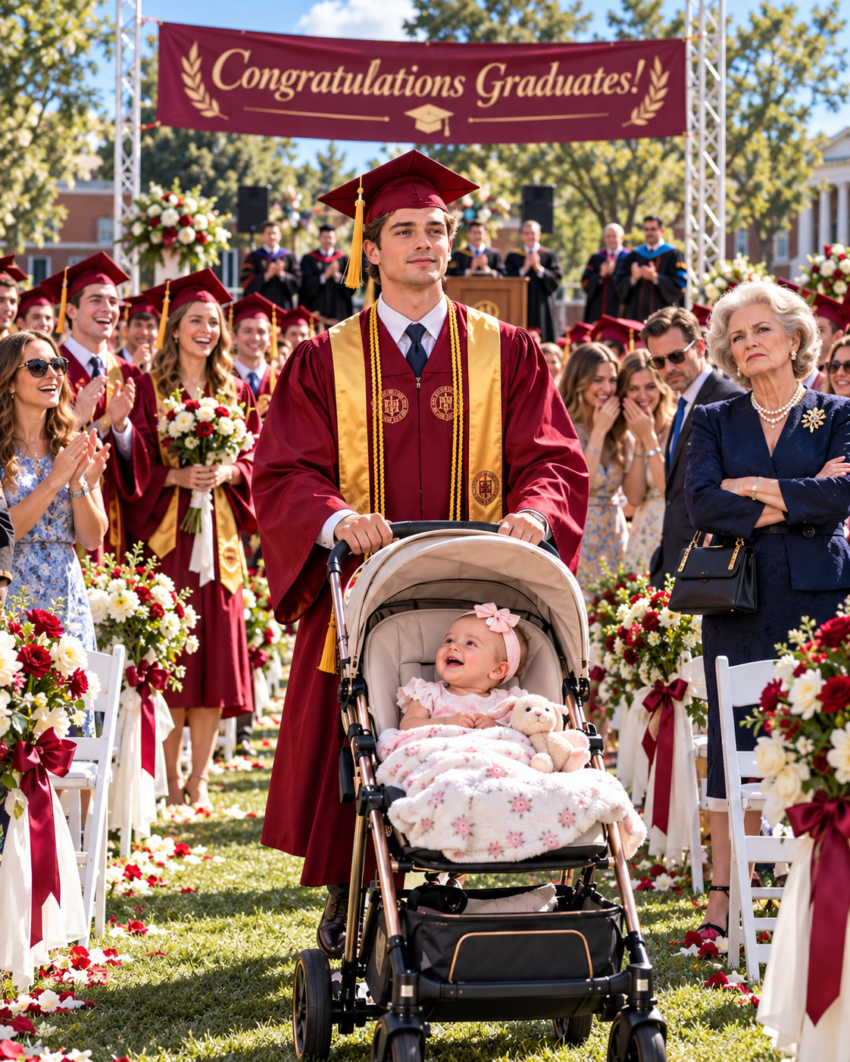
The Baby He Carried Across the Graduation Stage
The auditorium at Briarwood High School was overflowing with families, flowers, cameras, and the restless excitement that comes with graduation day.
Hundreds of parents filled the rows beneath bright banners displaying the school colors. Students in navy caps and gowns gathered near the stage, laughing nervously as they waited for their names to be called.
I should have been thinking about nothing except how proud I was of my son.
Instead, I couldn’t stop thinking about the hospital bills I had discovered beneath his mattress three days earlier.
My son, Caleb Mercer, was eighteen years old.
And somewhere inside St. Anne’s Medical Center, there was a premature baby whose medical expenses seemed somehow connected to him.
I still didn’t understand why.
But before that afternoon ended, everyone in the auditorium would know the truth.
The Boy I Raised Alone
I was seventeen when I learned I was expecting Caleb.
His father, Ryan, had promised that we would figure everything out together. He talked about getting a better job, renting a small house, and building a future.
Then one Tuesday morning, he disappeared.
His clothes were gone. His phone stopped working. His friends claimed they didn’t know where he was.
There was no dramatic goodbye.
There was simply an empty closet and a future I suddenly had to face alone.
From that day forward, Caleb and I became our own little family.
I worked wherever I could find steady hours. For years, I served breakfast at a diner outside Dayton, Ohio, and cleaned offices several evenings a week.
Money was always tight.
Caleb understood that much earlier than I wanted him to.
When he was eight, he stopped asking for expensive sneakers.
When he was twelve, he learned how to repair his old bicycle instead of asking for another one.
By sixteen, he was mowing lawns and doing landscaping work after school.
Sometimes I would come home exhausted and find twenty dollars beside the electric bill.
“Caleb, keep your money.”
He would shrug.
“We’re a team, Mom.”
Those words stayed with me.
Maybe because his father had taught me what leaving looked like.
Caleb taught me what staying looked like.
Something Changed

During Caleb’s senior year, everything seemed to be falling into place.
His grades were excellent. He had received acceptance letters from several colleges, and one had offered him a partial scholarship.
Then, about two months before graduation, he changed.
He started coming home late.
His phone was constantly buzzing.
He took every landscaping shift he could get, including weekends.
Sometimes I would find him sitting silently at the kitchen table long after midnight, staring at nothing.
“Are you okay?” I asked one night.
“Just tired.”
“Is something happening at school?”
He shook his head.
“I’m handling it, Mom.”
That answer worried me more than if he had simply admitted something was wrong.
I recognized that expression.
It was the face of someone trying to carry something too heavy without asking for help.
A Letter From the Past

Three days before graduation, an envelope arrived.
There was no return address.
Inside was a graduation card and a crisp hundred-dollar bill.
At the bottom, someone had written:
“Proud of him. — Ryan.”
I stared at the name.
Eighteen years.
That was how long Caleb’s father had been absent.
Eighteen years of birthdays, school plays, doctor appointments, scraped knees, report cards and difficult nights.
And suddenly he thought a hundred-dollar bill and three words made him part of our son’s life.
I put the card in a drawer.
But it awakened a fear I had spent years trying to bury.
Caleb had been secretive lately.
His father had disappeared when responsibility became difficult.
Was Caleb preparing to disappear from something too?
I hated myself for even thinking it.
Then I found the bills.
The Papers Under His Mattress

I was changing Caleb’s sheets while he was working when my hand touched something beneath the mattress.
I pulled out a thick stack of folded documents.
They were hospital statements.
At first, I assumed Caleb had been injured and hidden it from me.
Then I saw the department printed across the top.
Neonatal Intensive Care Unit.
NICU.
My stomach tightened.
The balances were enormous.
Several notices mentioned continuing care for a premature infant.
The patient’s name had been partially covered on the copies Caleb kept, but one name appeared repeatedly beside emergency contact information.
Madison Reed.
I had heard that name before.
Madison was a girl in Caleb’s graduating class.
I sat on his bed trying to understand what I was looking at.
Then my phone rang.
A woman from St. Anne’s Medical Center introduced herself.
“Are you Caleb Mercer’s mother?”
“Yes.”
“Your son is here. He’s fine, but we believe you should come in. He’s refusing to leave the neonatal unit.”
Twenty minutes later, I was driving faster than I ever had before.
The Truth Behind the Glass
I found Caleb standing outside the NICU.
He looked exhausted.
Beside him stood Madison.
She was pale and frightened, wearing an oversized sweatshirt and hospital wristband.
When Caleb saw me, his face fell.
“Mom…”
I held up the bills.
“Tell me what’s happening.”
He looked at Madison.
Then through the glass.
Inside an incubator was the smallest baby I had ever seen.
Caleb swallowed hard.
“Her name is June.”
I looked at him.
“Whose baby is she?”
His eyes filled with fear.
Not shame.
Fear.
“Mine.”
For several seconds, I couldn’t speak.
Caleb explained that Madison had discovered she was expecting late in the pregnancy. She had been terrified to tell her family because her parents cared deeply about reputation and social standing.
Then June arrived weeks early.
Everything changed overnight.
Caleb had been working extra hours because he wanted to help with expenses.
He had hidden everything from me because he believed I already had enough problems.
“I didn’t want you paying for another person because of me.”
I stared at my son.
“Caleb, why didn’t you tell me?”
His voice cracked.
“Because I was scared you’d look at me and see Dad.”
That sentence broke something open inside me.
I stepped forward and held his face between my hands.
“Look at me.”
He did.
“Being afraid doesn’t make you like your father.”
He said nothing.
“Leaving would.”
His eyes filled.
“I’m not leaving.”
“Then you’re already making a different choice.”
Madison’s Family
Madison came from one of the wealthiest families in the county.
Her grandfather had built a regional construction company, and her parents lived in a large home overlooking the country club.
Her mother, Victoria Reed, had apparently decided that the baby’s existence should remain private.
According to Madison, her parents had offered to arrange everything quietly.
They wanted Madison to leave town after graduation.
Caleb could stay out of the picture.
The baby could be cared for elsewhere until they decided what would happen next.
Caleb refused.
“June is my daughter,” he told them.
That decision had created a battle between two families that could not have been more different.
The Reeds had money, attorneys and influence.
Caleb had a landscaping paycheck, an aging car and me.
But he also had something they had underestimated.
He intended to stay.
Graduation Day
June improved enough to leave the hospital shortly before graduation.
Madison was still recovering emotionally and physically, and her relationship with her family had become painfully strained.
I assumed Caleb might skip graduation.
Instead, he woke early that morning and ironed his gown.
“You’re going?”
“I worked twelve years for that diploma.”
Then he looked toward the bassinet.
“And she’s coming too.”
When we arrived at Briarwood High School, whispers began almost immediately.
People recognized Madison.
People recognized the baby.
And people quickly realized Caleb was the father.
By the time the ceremony started, rumors had traveled through the auditorium.
The Reed family sat in the VIP section near the front.
Victoria looked as though she wanted to be anywhere else.
Madison sat beside me several rows away.
June slept peacefully against her chest.
Then Caleb’s name was called.
The Walk Nobody Expected
Caleb stood.
But instead of walking directly toward the stage, he came to our row.
He leaned down.
“Can I take her?”
Madison looked surprised.
“Right now?”
He nodded.
“Right now.”
She carefully placed June in his arms.
A wave of whispers moved through the auditorium.
Caleb adjusted the tiny blanket around his daughter and started toward the stage.
Someone laughed.
Then someone else did.
A few students turned to look at one another.
Caleb kept walking.
I could see how carefully he supported June’s head.
He wasn’t trying to create a spectacle.
He simply wasn’t hiding her.
As he passed the VIP section, I heard Victoria Reed say something to the woman beside her.
She didn’t realize how clearly her voice carried during the quiet between names.
“Just like his mother. People like that never change.”
My face burned.
Caleb stopped.
For one terrible second, I thought he might respond angrily.
Instead, he turned around.
Then he looked toward the principal.
“Sir, may I say something?”
The Moment the Room Fell Silent
The principal hesitated.
Then he handed Caleb the microphone.
My son stood in his graduation gown with his premature daughter sleeping against his chest.
His hands trembled slightly.
“I know some people are wondering why I’m carrying a baby across this stage.”
The auditorium became quiet.
“Her name is June. She’s my daughter.”
A few people shifted in their seats.
Caleb continued.
“I know becoming a father at eighteen wasn’t part of the plan people expected for me.”
He looked down at June.
“It wasn’t part of my plan either.”
Then he looked toward the VIP section.
“But sometimes your character isn’t measured by whether life follows your plan. It’s measured by what you do after the plan changes.”
Nobody moved.
“My father left before I was born.”
I stopped breathing.
Caleb had almost never spoken publicly about Ryan.
“My mother raised me by herself. She worked two jobs when she needed to. She skipped things she wanted so I could have things I needed. She taught me that love isn’t something you say when life is easy.”
His eyes found mine.
“Love is who stays.”
I covered my mouth.
“So yes, I’m eighteen. Yes, I’m scared. And yes, I have a lot to learn.”
He gently adjusted June’s blanket.
“But my daughter will never have to wonder whether her father wanted her.”
The silence in that auditorium was complete.
Then Caleb said the words I would remember for the rest of my life.
“If being like my mother means staying when leaving would be easier, then I hope I’m exactly like her.”
Someone began clapping.
Then another person stood.
Within seconds, almost the entire auditorium was on its feet.
The Diploma
Caleb handed the microphone back to the principal.
He walked across the stage carrying June.
The principal shook his hand and gave him his diploma.
For the graduation photograph, Caleb held the diploma in one hand and his daughter in the other.
There were no expensive clothes.
No carefully designed family image.
No attempt to pretend that life had gone perfectly.
There was simply an eighteen-year-old boy becoming a man in front of hundreds of people.
When Caleb returned to his seat, Madison was crying quietly.
She kissed June’s forehead.
“You didn’t have to do that.”
Caleb smiled.
“Yes, I did.”
Across the auditorium, Victoria Reed didn’t say another word.
One Year Later
A year has passed since graduation.
Our apartment is louder now.
There are bottles beside the sink, baby toys under the coffee table and tiny socks appearing in places where tiny socks should never be.
June is healthy.
She has bright eyes, a stubborn personality and an obsession with pulling books off shelves.
Caleb works full-time for the landscaping company and was recently promoted to crew supervisor.
At night, he takes accounting classes at the community college.
His original college plan changed.
His future didn’t disappear.
It simply took a different road.
Madison received financial aid and started nursing school. She says the NICU nurses who cared for June changed the direction of her life.
She and Caleb are learning how to be young parents one ordinary day at a time.
They make mistakes.
They get tired.
They disagree.
Then they figure things out.
Most importantly, neither one runs away.
What My Son Taught Me
Sometimes I sit at the kitchen table late at night and watch Caleb rock June to sleep while studying from an accounting textbook.
In those moments, I remember the fear I felt when I received Ryan’s graduation card.
I had wondered whether abandonment could somehow be inherited.
I know the answer now.
Our parents may shape us, but they do not get to decide who we become.
Caleb shares his father’s blood.
But he chose a different character.
And strangely enough, Victoria Reed’s cruel comparison turned out to contain a truth she never intended.
My son was like me.
He was scared, but he stayed.
He had fewer resources than the people judging him, but he refused to measure responsibility by the size of his bank account.
He understood something I had spent eighteen years learning:
Family is not proven by appearances, wealth or perfect circumstances.
It is proven by presence.
That graduation ceremony was supposed to mark the end of Caleb’s childhood.
Instead, it became the moment I realized my son had already understood the most important lesson I could ever have taught him.
When life became frightening, complicated and completely different from what he had imagined, he did not disappear.
He stepped forward.
And he carried his daughter with him.
Sometimes the strongest proof of love is not making a perfect promise about tomorrow, but choosing to remain present today when fear and uncertainty give you every reason to walk away.
A person’s beginning does not determine their ending, because even those raised in the shadow of abandonment can grow into people who choose loyalty, responsibility and compassion.
Becoming responsible for someone else before you feel completely ready can be frightening, but courage often begins precisely when we admit that fear and decide to move forward anyway.
Wealth may provide comfort and influence, but it cannot automatically create the kind of character that is built through sacrifice, consistency and the willingness to stand beside someone during difficult seasons.
Parents do not need to give their children a flawless life to leave them something valuable, because sometimes the greatest inheritance is simply teaching them what it means to show up every single day.
People may judge a family by its income, its address or the circumstances that brought it together, but none of those things can measure the love that exists behind closed doors.
Breaking a painful family pattern rarely happens through dramatic words alone; it happens when one generation consciously makes a different choice at the exact moment when repeating the past would be easier.
Life can change our plans without taking away our future, and sometimes the road we never intended to travel reveals strengths and purposes we might never have discovered otherwise.
Children remember far more than what their parents buy for them, because they also remember who came home, who kept trying, who listened and who remained beside them when circumstances became difficult.
In the end, Caleb’s greatest achievement that afternoon was not the diploma placed in his hand, but the quiet promise represented by the tiny daughter in his arms: whatever challenges came next, she would never have to question whether her father chose to stay.