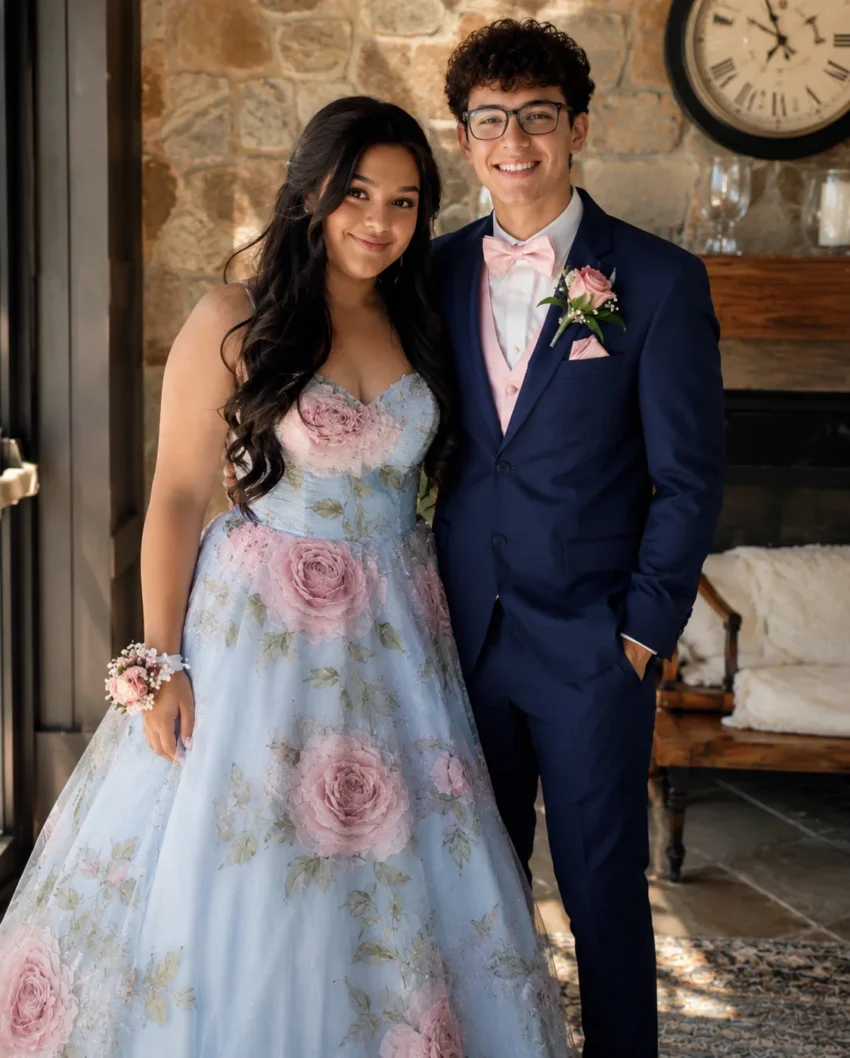
Eli Clark sat at my kitchen table at seven in the morning, scraping the yellow mustard off his rye bread with the flat edge of a butter knife. He had not spoken since he let himself in through the back door, and the silence from the hallway upstairs seemed to press down through the plaster ceiling.
“She did not eat her supper last night, Eli,” I said, setting a fresh carton of milk on the counter.
The price marker on the cardboard cap read four dollars and ten cents, written in thick black marker by the grocer down the hill. I rubbed my thumb over the cold wax paper, then began to rub the empty space on my left ring finger where my wedding ring used to sit.
“She will eat when she is ready, Mrs. Mave,” Eli said.
He did not look up from his sandwich, but his pencil lay beside his plate, the worn lead tip resting against the edge of a thick paper sketchpad. He was seventeen, but his shoulders had the heavy, rounded shape of an older man who spent his nights bent over a workbench.
“A person cannot live on air and quiet for a whole year,” I said. “It has been nearly twelve months since the accident, and she has barely left this house.”
Eli took a small, neat bite of his bread, his shoulder shrugged high.
“Mason would have made her eat,” he said.
The name landed between us like an unopened letter, heavy and cold. I waited for him to say more, but Eli only reached for his pencil and began tapping a steady, rhythmic beat against the side of his sketchpad.
“Sweetheart, she needs to come out of that room,” I said, leaning against the counter. “The high school is holding the senior prom in exactly three weeks, on Saturday, the fourteenth of May.”
Eli stopped tapping, the lead tip hovering just above the paper, but he kept his eyes lowered.
“She is not going to that,” he said.
“She has to,” I said. “If she does not go, she will spend the rest of her life behind that door.”
He did not answer, but his thumb moved over the cover of his sketchpad, hiding the bottom corner of a drawing from my view. I wanted to ask him what he was sketching, but he closed the pad with a soft thud and slid it into his canvas bag.
I stood by the sink, watching the grey Ohio rain drip from the aluminum gutters onto the hydrangea bushes outside. The silence returned, thick and stubborn, the very thing I had been trying to sweep out of the corners of this house since the funeral.
“Your mother told me you were up until midnight again,” I said, trying to soften my voice. “Sarah says you are going to fall asleep in your chemistry class.”
“I am fine,” Eli said. “My mother worries too much.”
“She is a nurse, Eli. It is her job to worry about people who do not sleep.”
“It is nothing,” he said, shrugging again.
He picked up his half-eaten sandwich, wrapped it carefully in a piece of wax paper, and tucked it into his pocket.
At fifteen past eight, I stood on the landing outside Hazel’s bedroom door, a clean basket of laundry balanced against my hip. The smell of lavender laundry detergent rose from the folded shirts, but it did not cut through the dry, shut-in scent of the hallway.
I leaned my ear against the painted wood, holding my breath so I could hear past the low hum of the refrigerator downstairs.
Inside, there was only the sound of shallow, rhythmic breathing, too light for a girl of seventeen.
“Hazel?” I called, keeping my voice soft, using that gentle tone that always made her sigh when she was younger. “I have your clean gray hoodie here, sweetheart. I can leave it on the knob.”
No floorboards shifted, and no sheets rustled in response.
She had spent three days in that room without opening the curtains, her world reduced to the space between her mattress and the wall.
I set the laundry basket down on the floor, my hand resting on the brass doorknob for a long moment before I let it go.
I could not shake the feeling that she was slipping away from me, vanishing into the plaster of her own bedroom.
In the quiet of the hallway, I looked at the small framed photograph hanging near her door. It was Mason and Hazel three summers ago at the county fair, their faces sunburned and sticky with cotton candy.
Mason had his arm around her shoulders, laughing so hard his eyes were shut, while Hazel looked straight at the camera with a small, secret smile.
That smile had vanished from our house the day the police cruiser pulled into our driveway on a Tuesday night in June.
Now there was only the sound of her breath through the keyhole, thin as paper.
I picked up the laundry basket again, carrying it back downstairs to the kitchen. The empty house felt too large for just the two of us, every room reminding me of the boy who wasn’t there and the girl who refused to be.
By mid-afternoon, the rain had slowed to a damp mist that clung to the screen door. I found them on the front porch, Hazel sitting on the top step with her knees pulled up to her chest, her oversized gray hoodie pulled down so low the sleeves covered her knuckles entirely.
Eli sat on the wooden glider opposite her, his sketchpad open on his lap, his pencil moving in quick, sharp strokes.
“The library was quiet today,” I said, letting the screen door click shut behind me. “Nobody came in but old Mr. Henderson looking for the morning paper.”
Hazel did not look up, her gaze fixed on a small crack in the concrete walkway where a dandelion was trying to grow.
“Hazel, sweetheart, look at me for just a second,” I said.
She shifted slightly, pulling the hood further over her face so that only the pale line of her jaw was visible.
“Eli is here,” I said, trying to force a lightness into my chest that I did not feel. “He came all this way to keep you company.”
“I am fine,” Hazel said.
Her voice was flat, the syllables short and clipped, as though she were rationing her breath.
Eli did not look up from his pad, but his pencil continued its steady scratching against the heavy paper, a private language between the two of them that I could not read.
“I was thinking we might drive over to Maple Street tomorrow,” I said, watching her carefully. “Just to look at the shop windows.”
Hazel stiffened, her fingers curling into the heavy gray fabric of her sleeves.
“No,” she said.
“It is only for an hour,” I said. “We do not have to buy anything, sweetheart. We could just see what they have.”
“I said no, Mom.”
Eli cleared his throat, his pencil pausing on a thick, dark line he was drawing near the center of the page.
“Mason wanted you to go,” Eli said, his voice quiet but steady.
Hazel flinched as if she had been touched with a cold finger, her shoulders rising under the heavy hoodie.
“Do not say his name,” she whispered.
“He told me,” Eli said, turning a page in his notebook with a dry rustle. “He said it three weeks before the accident.”
Hazel stood up, her movements sudden and awkward, and let herself back into the house without another word.
“You should not have said that, Eli,” I said, looking down at the empty step where she had been sitting.
“It is the truth,” Eli said. “He made me promise.”
“Promise what?”
He closed his notebook quickly, sliding the worn pencil into his shirt pocket, and stood up from the glider.
“Just that I would look after her,” he said. “It is nothing.”
He walked down the porch steps, his sneakers damp from the wet grass, leaving me alone in the grey afternoon light.
I stood there for a long time, watching him walk toward the road until his dark jacket disappeared behind the neighbor’s overgrown hedge.
At seven, the house was dark except for the small yellow lamp on the kitchen counter. I went up to Hazel’s room while she was downstairs in the bathroom, my heart heavy with the silence she had left behind.
I pushed her closet door open to hang her clean clothes, and my hand brushed against the heavy wool of Mason’s blue varsity jacket.
It hung at the very back, smelling of old cedar and the peppermint gum he used to keep in his pockets.
The jacket was far too large for Hazel, but I knew she had been sleeping with it pulled over her shoulders on the worst nights.
I held the sleeve for a moment, feeling the empty space where my son’s arm should have been, a space that felt wider and deeper with every passing month.
Hazel stood in the doorway, her eyes wide and dark in her pale face, her hands tucked deep into the front pocket of her gray hoodie.
“Why are you touching his things?” she asked, her voice cracking slightly.
“I was only putting your laundry away, sweetheart,” I said, turning to face her.
“Leave it alone,” she said. “Just leave everything alone.”
I looked at her, at the way she seemed to be shrinking inside her own clothes, trying to make herself small enough to disappear.
“We are going to Maple Street tomorrow, Hazel,” I said, my voice firmer than I felt. “We are going to find you a dress.”
“I told you I am not going,” she said.
“You are,” I said, rubbing the bare skin of my ring finger. “We are going to look, and we are going to find something beautiful.”
She did not yell, she did not cry; she simply stepped backward into the hallway and pulled her door shut until the latch clicked.
I stood in the center of her room, staring at the closed wooden door, waiting for a sound.
The clock on the wall said ten minutes past ten when I spread the glossy pages of the prom dress catalogs across the coffee table. Hazel had slipped down the stairs, her feet silent on the rug, and sat on the third step from the bottom.
“Look at this blue one, sweetheart,” I said, pointing to a dress with a satin bodice. “It has the same high neckline you liked last year.”
Hazel pulled the sleeves of her oversized gray hoodie down over her knuckles, burying her hands entirely. She did not look at the catalog, but her gaze was fixed on the corner of the table, steady and heavy.
“We have three weeks before the dance,” I said, rubbing the empty skin where my wedding ring used to sit. “We should order soon if we want it to arrive in time for alterations.”
She did not shift her weight on the wooden step. Her flat, quiet voice barely reached me across the rug.
“I am not going, Mom.”
“It is just a look, Hazelnut,” I said, using the old name her father had given her. “No one is forcing you to buy anything today.”
“I told you,” she said, her shoulders tightening under the thick gray fleece. “I am not going.”
She stood up, the fabric of her oversized sweater swishing against her knees as she turned back up the stairs, leaving the blue gown on the paper between us.
At one o’clock, I walked down to the Millfield post office to pick up the mail, the rain still dripping from the aluminum gutters of the storefronts along the square. The air smelled of wet asphalt and old paper.
Behind the counter, Arthur handed me three circulars and a heavy square envelope with a foil border.
“This came in the noon delivery for Hazel,” Arthur said, leaning his elbows on the counter. “Looks like one of those school invitations.”
I looked down at the handwriting on the front, thick and black, written with a felt-tip pen. The card was addressed to Hazle Mave.
The letter ‘e’ was swapped with the ‘l’, a clumsy mistake, or perhaps not a mistake at all, given how long we had lived in this town. My fingers cooled as I held the cardboard edge.
“Is everything all right, Clara?” Arthur asked, squinting through his bifocals.
“Yes,” I said, slipping the envelope into my purse between the library deposit slip and my wallet. “Just some school paperwork.”
I walked out into the damp afternoon, the heavy square envelope pressing against my hip.
The kitchen table was set for two by six o’clock, the yellow bowls filled with vegetable soup that had cost three dollars and fifty cents for the ingredients. Hazel sat across from me, her spoon resting against the ceramic rim without moving.
“I looked at the savings account this morning,” I said, keeping my voice bright and even. “We have two hundred and fifty dollars set aside for a dress, and Sarah says we can borrow her sewing machine if we need to hem anything.”
Hazel stared into her bowl, the steam rising between us, dampening the loose strands of hair around her face.
“Eli has been working on some sketches,” I said. “He told me he had a few ideas.”
“Eli does not know,” Hazel said, her voice dropping into that flat, one-syllable tone.
“He wants to help, sweetheart,” I said, reaching across the table to touch her arm, but she pulled her sleeve further down, her wrist disappearing into the gray cotton. “We all do.”
She pushed her bowl three inches away, the soup splashing slightly against the side.
“Nobody can help,” she said.
She stood up, her chair scraping against the linoleum, and walked toward the hallway without looking back.
At nine o’clock, the house was entirely quiet except for the low hum of the refrigerator in the kitchen. I carried a glass of water up the stairs, my hand steady on the wooden railing.
The door to Hazel’s room was slightly ajar, a narrow sliver of yellow light cutting across the dark floorboards of the hall. I pushed it open with my elbow.
Hazel was sitting on the edge of her mattress, her back to me, her shoulders hunched forward in a tight, protective curve. She was slid down toward the floor, her hand reaching deep beneath the box spring.
As the door clicked against the frame, she jumped, her shoulders jerking upward. She shoved a thick green notebook under the edge of the mattress, her movements fast and desperate.
“Sweetheart, I brought you some water,” I said, setting the glass on her bedside table next to a stack of unread textbooks.

“I was going to sleep,” she said, her back still toward me, her hands tucked under her arms.
“I saw you put something away,” I said, my eyes drifting to the slight bulge in the floral dust ruffle where the mattress met the frame. “Is that a school journal?”
“It is nothing,” she said, her voice dropping even lower. “Just leave it, Mom.”
I stood in the doorway for a long moment, the cool water in the glass reflecting the pale light of her bedside lamp.
I did not reach for the mattress, but the weight of that hidden green book remained in the room, solid and cold.
When I went downstairs to the kitchen, I pulled the misspelled invitation from my purse and laid it flat on the counter under the bright bulb.
The ink of the misspelled name seemed darker now, the letters thick and deliberate.
I held the misspelled invitation, feeling a chill.
I slipped the invitation back into its envelope and walked up the stairs, my thumb tracing the bare, smooth skin where my wedding band had lived for twenty-two years.
I knocked on Hazel’s door, the wood cool against my knuckles.
“Sweetheart,” I said, leaning toward the narrow crack she always left open.
There was no sound from inside, only the faint, dry rustle of her sheets as she shifted her weight.
“Just try one on,” I said, keeping my voice soft and steady. “We do not have to buy anything. We can just go look.”
She did not answer, but I could hear her shallow breathing near the door, a tiny sound that felt like a wall between us.
“One dress, Hazel,” I said. “If we go to the shops today and you try on just one, I promise I will not say another word about the prom.”
A long silence followed, the kind that usually ended with her turning her back to the wall.
“Any dress?” her voice came, flat and small from the shadows of her room.
“Any dress you like,” I said, holding my breath. “We will find something that makes you feel like yourself.”
“And then you drop it,” she said.
“Yes,” I said, though my chest felt tight with the lie. “We will come straight home, and I will drop it.”
The door creaked open another inch, revealing the edge of her oversized gray hoodie, the cuffs pulled down so far they completely hid her hands.
“Ten o’clock,” she said.
The door clicked shut, the small brass latch settling into place with a sound that felt entirely too final.
I stood in the hallway for a moment, listening to her move back toward her bed, her steps light and hesitant.