Chapter 1: The Voice My Daughter Heard
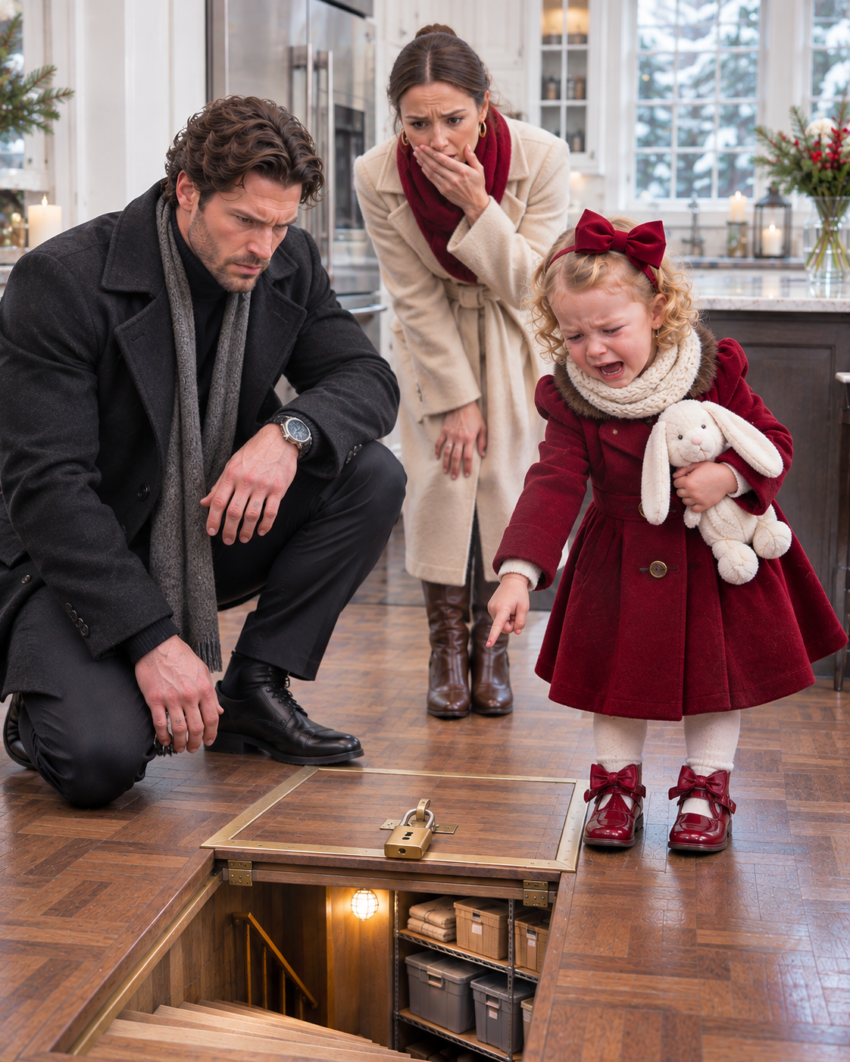
The first time my two-year-old daughter told me her mother was beneath our kitchen floor, I thought she was confused.
The second time, my new wife turned pale.
But when my daughter pressed her tiny hand against the floorboards and whispered, “Daddy, Mommy is down there. She’s waiting for us,” I heard something that made my heart nearly stop.
Three knocks. A short pause. Then two more.
It was a sound I knew better than almost anything.
My former wife, Camille, had invented that little signal when our daughter was born. She used it on the nursery door, on the kitchen table, and sometimes against the window when she came home.
Three knocks meant I’m here.
Two more meant I love you.
And now someone was making that exact sound beneath my feet.
My name is Everett Whitaker. I was thirty-seven years old, worked as a heating and ventilation technician, and lived in a quiet neighborhood outside Columbus, Ohio.
I thought I understood my family.
I had no idea how much I had missed.
Chapter 2: The Locked Basement

My daughter, Maisie, stood beside me in her pink pajamas, holding her favorite stuffed rabbit.
Her little face was serious.
“Mommy knocked, Daddy. I heard her.”
Behind us, my new wife, Delaney, gave a nervous laugh.
“Everett, she’s just missing Camille. You know how children imagine things.”
I might have believed her if I hadn’t noticed the basement door.
Someone had installed a brand-new padlock.
I had gone downstairs the previous afternoon to retrieve a toolbox. There hadn’t been a lock then.
“Why is the basement locked?” I asked.
Delaney folded her arms.
“Maisie keeps wandering toward the stairs. I was trying to keep her safe.”
“Then where’s the key?”
She hesitated.
Before she could answer, another sound came from below.
A faint voice.
“Everett? Please, can you hear me?”
I recognized that voice immediately.
Camille.
My former wife, the mother of my child, was somewhere beneath our kitchen.
I grabbed my phone and called 911.
Delaney reached toward me.
“Please don’t call anyone. There’s something you don’t understand.”
I stepped away.
“Then explain why Camille is locked in my basement.”
She said nothing.
And that silence frightened me more than any answer could have.
Chapter 3: The Woman I Thought I Knew

Camille and I had been married for nearly eight years.
We met at a community fundraiser when we were twenty-four. She was an elementary school librarian with a bright smile and a habit of remembering little details about everyone she met.
For years, we were happy.
Then life became complicated.
I accepted extra shifts to pay our mortgage. Camille spent months helping her father through a serious illness. We grew tired, stopped talking honestly, and slowly became strangers sharing the same house.
Our divorce was painful but peaceful.
We agreed that Maisie deserved two parents who could still treat each other with respect.
Camille never missed a scheduled visit. She called every evening, remembered every appointment, and kept every promise she made to our daughter.
Six months after our divorce, I met Delaney.
She was charming, thoughtful, and seemed genuinely interested in Maisie.
When we married, I believed I was giving my daughter another caring adult in her life.
But lately, Delaney had changed.
She complained whenever Camille visited. She insisted that Maisie needed fewer interruptions between households.
Sometimes she suggested that Camille wasn’t responsible enough to raise our daughter.
I dismissed those comments as jealousy.
Now, standing beside that locked basement door, I wondered whether I had ignored something far more serious.
Chapter 4: Five Knocks in the Darkness
I carried Maisie to our neighbor, Mrs. Fletcher, and asked her to keep my daughter inside until the police arrived.
Then I returned home.
Delaney was standing in the kitchen, staring at the basement door.
“You can still tell me what’s happening,” I said.
Her eyes filled with tears.
“I was trying to protect our future.”
“From Camille?”
She looked toward the backyard.
“Everett, there are people involved who won’t be happy if you open that door.”
My stomach tightened.
“What people?”
She shook her head.
“Please. Just wait until tomorrow.”
Tomorrow?
Camille might have been down there for hours.
I couldn’t imagine leaving her another minute.
I retrieved a pry bar from the garage and forced the padlock loose.
Cold air drifted up the staircase.
The basement lights wouldn’t turn on.
“Camille!” I called.
“I’m here,” she answered weakly. “But please be careful.”
I switched on my flashlight.
At the bottom of the stairs stood another locked door.
Beside it was a blue storage cooler connected to a small electronic device.
“Don’t touch that,” Camille warned. “Someone said he’d know if anybody opened the room.”
I stopped immediately and told the emergency dispatcher what I had found.
Then a noise came from the backyard.
Through the kitchen window, I saw a man in a dark jacket moving quickly toward the fence.
When he noticed me watching, he ran.
Delaney covered her mouth.
“He wasn’t supposed to come back yet,” she whispered.
Chapter 5: The Secret Behind the Second Door
Police officers arrived minutes later.
They secured the house and examined the device before opening the basement storage room.
I stood on the stairs, barely able to breathe.
When the door finally opened, I saw Camille sitting against the wall.
Her clothes were dusty, her face was pale, and she looked completely exhausted.
A medical team immediately came forward to help her.
She lifted her head when she heard my voice.
“Everett? Where’s Maisie?”
“She’s safe. She’s with Mrs. Fletcher.”
Camille closed her eyes.
Tears slipped down her cheeks.
“Thank goodness. I was so afraid they would get to her.”
I crouched beside her once the officers said it was safe.
“Who did this, Camille?”
She looked toward the staircase.
“Delaney wasn’t working alone.”
“I saw a man outside.”
“There are others,” she whispered. “And they needed me to disappear before tomorrow morning.”
I stared at her.
“Why tomorrow?”
Camille took my hand.
“Because someone is trying to take Maisie away from both of us.”
At that moment, an officer approached carrying Delaney’s phone.
A message had appeared on the screen.
Did he find the room? Make sure nobody sees the documents.
I suddenly understood that what happened in our basement was only one part of a much larger plan.
Chapter 6: The Documents Nobody Was Supposed to Find
At the hospital, Camille finally explained what she knew.
Three weeks earlier, she had discovered unusual activity involving a trust established by her late father, Walter Barlow.
Walter had owned a successful regional building-supply company. Before his passing, he had arranged for part of his estate to support Maisie’s education and future.
The trust was managed independently, with strict conditions protecting the money until Maisie reached adulthood.
Camille had recently received a letter about an attempted change to the trust’s administrative records.
The request included documents she had never signed.
She contacted the family attorney, Miriam Caldwell, who immediately became concerned.
Someone appeared to be using Camille’s personal information without permission.
“I thought it was a paperwork mistake,” Camille told me. “Then Miriam found another document with your name on it.”
My heart sank.
“My name?”
She nodded.
“It claimed you supported transferring control of Maisie’s financial affairs to a new guardian.”
I stared at her in disbelief.
“I never agreed to anything like that.”
“I know,” she answered. “That’s why I came to your house yesterday. I wanted to speak to you before anyone else knew.”
According to Camille, Delaney had invited her inside, saying I would be home shortly.
But instead of finding me, Camille encountered a man she had never met.
They insisted she stop asking questions about the trust.
When she refused, they kept her inside the basement storage room.
Their plan depended on making her unreachable while questionable documents were submitted.
The more Camille explained, the more I realized that my marriage to Delaney had given someone access to our family’s private information.
Chapter 7: The Man Behind the Plan
Over the following days, investigators uncovered connections I never would have imagined.
The man seen fleeing our backyard was identified as Graham Pritchard, a former financial consultant who had previously worked with one of Walter Barlow’s business associates.
Graham had been experiencing financial difficulties.
He believed that gaining influence over Maisie’s trust could solve his problems.
Delaney had known him long before she met me.
Phone records, financial transactions, and messages showed that their relationship had continued throughout our marriage.
They had discussed Camille’s custody arrangements, my work schedule, and the documents needed to support their plan.
One message from Delaney was especially difficult to read.
Everett believes whatever I tell him about Camille. He won’t question the paperwork.
I sat in the attorney’s office, staring at those words.
For months, I had defended Delaney whenever Camille expressed concerns.
I had assumed my former wife was struggling to accept my new marriage.
Now I understood that Camille had been trying to warn me.
“I should have listened,” I told her.
She sat across from me, her hands folded around a cup of tea.
“You couldn’t have known everything,” she said gently. “But we both need to learn from what happened.”
I nodded.
For the first time in years, we were having an honest conversation without anger or defensiveness.
Chapter 8: The Truth Finally Reaches the Court

The investigation continued for several months.
Authorities gathered evidence concerning the basement incident, the questionable financial documents, and the attempts to interfere with Maisie’s guardianship arrangements.
The trust administrator rejected the unauthorized requests, and the family’s attorney helped ensure that Maisie’s financial protections remained intact.
Delaney and Graham eventually faced legal consequences for their involvement.
Other individuals connected to the paperwork were investigated separately.
Nothing about the process was quick.
There were interviews, hearings, difficult questions, and long days when Camille and I wished we could simply return to ordinary life.
But we agreed on one thing.
Maisie would never be responsible for carrying the weight of adult decisions.
We worked with a family counselor to explain what had happened in language she could understand.
“Mommy was stuck somewhere, but the helpers came,” Camille told her.
Maisie looked at me.
“Because I heard Mommy knock?”
I smiled through tears.
“Yes, sweetheart. You heard her, and you told me.”
She considered that for a moment.
Then she wrapped her little arms around Camille.
“I always know Mommy’s knock.”
I had spent years believing that being a good father meant providing a comfortable house and a steady income.
My daughter had taught me that being present and listening carefully mattered just as much.
Chapter 9: Learning to Become a Family Again
After the investigation, Camille and I began spending more time together.
At first, it was entirely about Maisie.
We took her to the park, attended preschool activities, and shared meals on special occasions.
Then something unexpected happened.
We started talking about ourselves.
Not about attorneys, custody arrangements, or old arguments.
We talked about books, our jobs, childhood memories, and the small things we had once enjoyed together.
One afternoon, while Maisie played in the backyard, Camille asked me a question.
“Do you ever wonder whether we gave up too soon?”
I looked at her.
“Every day lately.”
She smiled sadly.
“We were both so tired back then.”
“I thought working harder would fix everything,” I admitted. “I didn’t realize how lonely you felt.”