But the ambulance was already pulling into the emergency bay, doors thrown open, and Rowan was rushed inside under bright hospital lights that made Maisie squint like someone who hadn’t been under clean fluorescent glow in a long time
The Night The Station Door Chimed
The clock above the front desk of the Cedar Hollow Police Department read 9:47 p.m. when the glass door swung inward with a small, polite chime, and Officer Nolan Mercer lifted his head from a stack of reports, already forming the practiced sentence he used when someone wandered in late, because the building quieted down after hours and most folks came tomorrow, not now, not this close to closing.
Then he saw her.
She was maybe seven, small enough that the handle of the door sat near her shoulder, and she looked like she had walked a long way on feet that were never meant to carry someone through cold pavement and gravel, because her soles were dirty, her toes were nicked in a dozen tiny places, and her clothes hung on her like they belonged to a different kid with a different life.
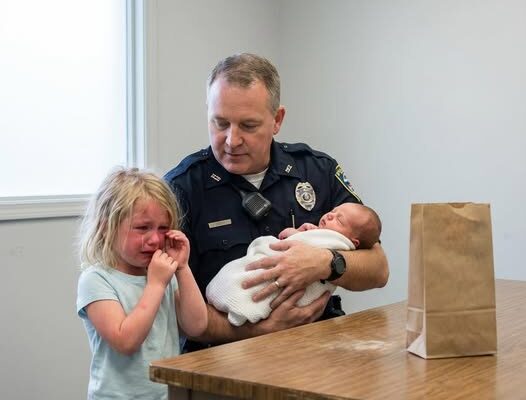
But it was her face that stopped him, her cheeks wet with tears that made clean streaks through the grime, her eyes wide in a way that did not match her age, and her arms wrapped around a brown paper bag held tight against her chest as though she believed her grip alone could keep something from slipping away.
Nolan stood slowly, careful not to move too fast, because frightened children read speed as danger the way adults read sirens.
“Hey there, sweetheart,” he said, letting his voice stay low and steady even as his stomach tightened. “You’re safe here. Are you hurt? Can you tell me what’s going on?”
The girl took one shaky step forward, then another, and when she spoke her words came out thin, as though she had been saving breath for the walking.
“Please,” she whispered. “He isn’t moving. My baby brother… he isn’t moving.”
A Bag Held Like A Promise
Nolan felt his body go cold in that particular way it does when the brain tries to sprint ahead of the heart, because the mind starts naming possibilities and the chest refuses to keep up.
“Your brother is here?” he asked, already moving around the counter. “Where is he right now?”
She didn’t answer with a direction, or a street, or a house number, because she didn’t have the kind of life where you trusted adults with addresses, so she simply held out the bag with hands that trembled so hard the paper crinkled.
Nolan took it carefully, one palm under the bottom as if it contained glass, and only then did he notice the stains along the seam, dark and rust-colored, soaking the paper in uneven patches.
His throat tightened, but he opened it anyway, because there are moments when you do what must be done even while part of you begs the world to prove you wrong.
Inside, wrapped in old towels that had once been white, lay a newborn, so small that the towels looked oversized, and for one awful second Nolan thought the child was gone from this world entirely, because the baby’s lips were tinted faintly, and his skin felt too cool when Nolan touched the tiny cheek with the back of his finger.
Then he saw it, barely there, the slightest rise and fall of a miniature chest, like a fragile wave that might stop if anyone blinked too hard.
Nolan’s voice broke as he turned and shouted toward the back hall.
“Call an ambulance now! Tell them we have a newborn in critical condition!”
Sirens In The Distance, Breaths Up Close
The station snapped awake the way quiet places do when emergency steps inside, phones ringing, chairs scraping, radios crackling, while Nolan lifted the baby from the bag and cradled him against his uniform, using his own warmth because it was the only warmth available in that instant.
The girl clutched Nolan’s sleeve with surprising strength, her fingers digging into the fabric like she was afraid he might vanish, too.
“I tried,” she said, words tumbling out with her tears. “I used all the towels. I rubbed his hands like they do on TV, and I tried to give him water with my fingers, just a little, but he got so quiet, and then he just… he just stopped.”
Nolan swallowed, because he needed to stay steady, because he could not let a child carry even one more ounce of blame.
“You did the right thing bringing him here,” he told her. “You did exactly the right thing.”
The ambulance arrived in minutes, lights flaring against the dark windows, and the paramedics moved with practiced speed, placing a small oxygen mask over the baby’s face, checking tiny pulses, speaking in clipped phrases that sounded like another language.
One of them glanced up briefly, eyes serious.
“He’s fighting, but he’s severely dehydrated and very cold,” the paramedic said. “We need to move, right now.”
Nolan didn’t hesitate.
“I’m coming,” he said, and when the girl started to shake her head as if she feared she’d be left behind, he added, “And she’s coming with us.”
Maisie And Rowan
In the back of the ambulance, the girl sat close enough to Nolan that their shoulders nearly touched, her gaze locked on the baby as if watching could keep his breath going.
Nolan leaned slightly toward her so she didn’t have to fight the roar of the road and the wail of the siren.
“What’s your name?” he asked.
“Maisie,” she whispered. “Maisie Kincaid.”
“And your brother?”
Her lower lip trembled.
“Rowan. He’s Rowan. I’ve been taking care of him since he got here.”
The way she said it, like it had always been her job, like she had never been asked if she wanted it, made Nolan’s stomach twist.
“Maisie,” he said gently, “where is your mom?”
Her eyes dropped to her hands, and her fingers worried at each other like knots.
“She can’t know I left,” Maisie said. “She gets confused. Sometimes she forgets things, and sometimes she forgets me, and if she gets scared she hides, and then there’s a man who brings food sometimes, and he said I’m not supposed to talk about him, because it’s a secret.”
Nolan felt a chill crawl up his spine.
“What man?” he asked, careful, slow.
But the ambulance was already pulling into the emergency bay, doors thrown open, and Rowan was rushed inside under bright hospital lights that made Maisie squint like someone who hadn’t been under clean fluorescent glow in a long time.
Bright Lights And Quiet Questions
The pediatric emergency unit at Cedar Hollow Regional Medical Center hummed with urgency, nurses moving fast, monitors chiming, and a doctor with kind eyes and hair pinned back in a neat twist stepped forward as the team wheeled Rowan through swinging doors.
Dr. Tessa Markham glanced at the baby and her expression sharpened into controlled focus.
“How long has he been like this?” she asked.
Maisie’s voice barely carried.
“He got quiet this morning. I tried to wake him up, but he didn’t open his eyes.”
Dr. Markham’s jaw tightened.
“We’re going to stabilize him immediately,” she said, then looked at Nolan. “Officer, I need room to work.”
Nolan nodded, then guided Maisie to a waiting chair, keeping one hand lightly on her shoulder so she knew she hadn’t been abandoned.
When the doors swung shut, Maisie stared at them as if her whole world sat behind that strip of plastic and metal.
After a few minutes of silence, Nolan pulled out his notebook, not because he wanted to interrogate a child, but because the only way to protect her was to understand what she’d been living inside.
“Maisie,” he said softly, “I’m going to ask some questions, and you can answer only what you can, okay? You’re not in trouble. I just need to make sure you and Rowan are safe.”
She nodded, small and stiff.
“Tell me about the man who brings food,” Nolan said.
Her face went pale.
“I don’t know his name,” she admitted. “Mom called him ‘the helper.’ He comes when it’s dark, and he never comes inside, he just leaves bags on the porch, and sometimes he sits in his car down the road, like he’s watching.”
The House That Didn’t Feel Lived In
By the time Nolan drove out toward the address Maisie finally whispered, the roads were empty, the town lights fading behind him, fields stretching into blackness, and the quiet made everything feel louder, from the tires on gravel to the wind rattling dried weeds along the ditch.
With him was Sheriff Rhea Langford, who didn’t waste words, because sheriffs learn early that chatter doesn’t make uncertainty smaller.
The house sat back from the road, half-swallowed by tall grass, with paint peeling in strips and a porch that sagged like it was tired of carrying anyone’s weight.
Sheriff Langford swept a flashlight beam across the dirt drive.
Fresh tire tracks.
And on the porch, a plastic grocery bag that looked too new for a place that otherwise looked forgotten.
They approached, called out, tried again, and when there was no answer, Nolan tested the door.
It swung open.
Inside smelled like long-standing neglect, not the dramatic kind that belongs in movies, but the stale, ordinary kind that happens when people stop having enough energy to keep up, and the world quietly piles up around them.
The groceries on the counter were basic, recent, and oddly careful, as if someone had chosen items that required minimal cooking.
Someone had been helping.
Someone had also been hiding.
In a back room that looked like it had once been meant for a child, Nolan found a thin mattress on the floor, a few blankets, and a notebook with crayon drawings and uneven handwriting that made his throat tighten before he even understood why.
The drawings showed a woman lying in bed with wide eyes, a small girl carrying bottles of water, and a tall shadow of a man always placed outside the house, always outside, always close.
Between drawings were tallies and notes.
“The helper came.”
“He came again.”
“He left medicine.”
Then, weeks later: “Mom’s belly is bigger. He knows.”
And days before Rowan’s birth: “He left towels and warm water. How did he know?”
Sheriff Langford read over Nolan’s shoulder, her face hardening.
“This isn’t charity,” she said quietly. “This is monitoring.”

A Mother In The Storm Cellar
The next morning, search teams returned, because Maisie had said her mother sometimes hid for hours when she heard noises, and Nolan couldn’t shake the thought of that child sitting alone with a newborn, listening to the wind and waiting for an adult who wasn’t coming.
Behind the house, half-covered by weeds, they found storm-cellar doors, rusted but not locked.
Nolan went down first, flashlight cutting through dusty air, calling gently into the darkness.
“Ms. Kincaid,” he said. “I’m Officer Mercer. Maisie is safe. Rowan is at the hospital. They need you.”
A small sound came from the far corner, and Nolan found her there, curled tight, hair matted, clothes hanging loose, eyes open but distant, like her mind had retreated somewhere unreachable.
Kara Kincaid didn’t fight when paramedics lifted her, didn’t speak, didn’t seem to understand where she was going, and Dr. Markham later explained with a careful honesty that made the room feel heavy.
“Her body is depleted, and her mind has shut down as a way to survive,” Dr. Markham said. “With proper treatment, she may come back to herself, but this didn’t start yesterday.”
The Helper With A Hidden Name
Back at the station, Nolan spread out evidence like a map: Maisie’s notebook pages photographed, grocery receipts found near the trash, time stamps from traffic cameras on the county road.
At 2:17 a.m. on a Tuesday three weeks earlier, a dark sedan slowed near the house, paused, then crept forward again.
Nolan zoomed in, sharpened what he could, and when the plate number came back partial-but-enough, the registration hit him like a punch.
The car belonged to Arthur Kincaid, Kara’s uncle, a man with a tidy address in a quiet neighborhood, a church volunteer history, and a reputation built like a fence: tall, clean, and meant to keep mess out of sight.
When Nolan and Sheriff Langford knocked, Arthur opened the door too quickly, as if he’d been standing behind it, listening.
“Officers,” he said, voice polite, hands not quite steady. “Is something wrong?”
Nolan held up the traffic still.
“We need to talk about your niece,” he said. “And the supplies you’ve been leaving at night.”
Arthur’s shoulders sagged as if his body finally admitted what his mouth had been denying for a year.
“I can explain,” he whispered.
Sheriff Langford didn’t soften.
“Start,” she said.
Arthur sat, stared at his own hands, then spoke in a string of long, ashamed sentences that circled the same truth from different angles: he had found Kara living in that house, had seen Maisie, had panicked over what the town would say, had convinced himself that quiet help was better than public intervention, and had chosen secrecy over safety because he wanted to protect a reputation that never deserved protecting more than a child deserved protection.
Nolan felt anger rise, but he kept his voice controlled, because rage didn’t save anyone.
“You watched a child carry adult responsibilities,” Nolan said, each word measured. “You watched a newborn arrive into conditions no baby should ever face, and you still didn’t call for real help.”
Arthur’s eyes filled.
“I thought I was doing something,” he said. “I thought… I thought someone else would step in.”
Sheriff Langford’s cuffs clicked.
Arthur looked at Nolan desperately.
“Are the kids okay?”
“They’re okay because Maisie refused to quit,” Nolan said. “Not because you were careful in the dark.”
A Second Man In The Background
Even with Arthur in custody, the story wouldn’t sit still, because Maisie kept mentioning another figure, a man who sometimes met her mother at night, a man who provided money, a man Kara had called “the director,” and when Nolan heard that word, something in him tightened, because small-town titles carry weight and hide people in plain sight.
Dr. Maren Sloane met with Maisie in a quiet hospital room with crayons and paper, giving the child space to speak without pressure, and Maisie drew the same shadow again, only this time she added a detail: a bumper sticker she remembered, white lettering she couldn’t read at the time, but a logo she could describe.
“It was from the community college,” she said, eyes fixed on the paper. “Mom had pictures from there, too, and she cried when she looked at them.”
Nolan pulled old yearbooks, staff directories, archived student conduct files, because a good story always has paper somewhere, and paper has a way of revealing what people try to bury.
Kara had once been a nursing student with strong grades, and then she had left suddenly, with records mentioning complaints that were minimized, concerns that were dismissed, and a signature that appeared too often at the bottom of decisions that made the situation “go away.”
The name was Harvey Keaton, a senior administrator at Cedar Hollow Community College, married, respected, photographed often with civic leaders, and praised for “service” in the way men get praised when nobody asks who paid the cost of their success.
The Hearing That Could Have Broken Them
While Nolan and Sheriff Langford pushed the criminal side forward, a different kind of battle brewed in living rooms and offices, because systems have their own momentum, and they don’t slow down just because a child’s heart is on the line.
A state placement coordinator, Denise Kline, arrived with a briefcase and an expression that treated the situation like a scheduling problem.
She spoke in tidy sentences about “best outcomes,” about newborn placements moving fast, about older children being “harder to match,” and about separating siblings because “the bond can be complicated,” as if love was a complication rather than the only thing that had kept Rowan breathing long enough to find help.
A foster caregiver who had stepped in immediately, Cecilia Hart, listened with her jaw clenched, then looked over at Maisie, who sat on the edge of the couch with her hands curled tight in her lap like she was physically holding herself together.
When Maisie finally spoke, her voice was rough from crying.
“I did everything right,” she said. “I walked all the way there. I kept him warm. I didn’t stop. Please don’t take him from me.”
That night, Maisie slipped out of Cecilia’s house and walked back to the hospital, because frightened children return to the one place they believe cannot move away from them, and security found her on the floor near the neonatal unit, her palm pressed to the glass as if she could comfort Rowan through it.
Nolan crouched beside her, careful.
“Everybody’s looking for you,” he said.
Maisie didn’t look up.
“I’ll run again,” she whispered. “Every time.”
A Judge Who Finally Looked Closely
By the time the family court hearing arrived, evidence was stacked in neat folders, medical reports documented Rowan’s condition on arrival without dramatics, Dr. Sloane’s evaluations explained the emotional harm separation would cause, and Cecilia had filed to become guardian for both children, not as a savior with a spotlight, but as an adult willing to do the unglamorous work of daily care.
Kara, medicated and steadier, was transported with supervision, because she was still fragile, still recovering, still learning how to be present without being overwhelmed by fear.
In the courtroom, Judge Patrice Ellison listened with the kind of attention that made the room quiet, because attention is rare and people can feel it when it shows up.
Maisie sat small in a chair that was too big, feet not reaching the floor, hands folded like she was trying to appear older than she was.
Judge Ellison’s voice was calm.
“Maisie, do you understand why you’re here today?”
“Yes, ma’am,” Maisie said, swallowing hard. “You’re deciding if me and Rowan can stay together.”
“What do you want?”
Maisie took a breath that looked like it hurt.
“I want to stay with my brother,” she said, words steadying as she went, “and I want Ms. Hart to take care of us, because she promised we’d be together, and my mom loves us, but she needs help, and I don’t want anyone to think she’s bad, because she’s just… not okay right now.”
When Kara stood, her hands shook, but her voice held.
“Your Honor, I love my children,” she said, blinking through tears, “and I want them safe more than I want anything, even if it hurts, and I want them together, because they’ve only ever had each other.”
The judge paused, looking down at the papers, then up at the people, then back to Maisie, as if making herself see the entire truth and not only the clean parts.
“This court is granting full guardianship of both children to Cecilia Hart,” Judge Ellison said finally, voice firm. “The siblings will remain together, and the mother will continue treatment with supervised contact as medically appropriate.”
Maisie’s face crumpled, and Cecilia pulled her into an embrace that didn’t feel like victory so much as relief after holding your breath too long.
Nolan exhaled slowly, because sometimes the best outcome is simply the one that stops the damage from spreading.
Six Months Later, Under Winter Lights
Six months later, the elementary school auditorium smelled faintly of construction paper and winter air, and first graders stood in rows wearing red and green, shifting their weight, whispering, smiling at parents.
Maisie stood near the front, wearing a simple red dress Cecilia had picked carefully, hair brushed smooth, cheeks warm, eyes bright in a way that looked new on her face.
In the first row, Cecilia held Rowan, now rounder and stronger, his gaze darting toward the stage as if he recognized something familiar in the shape of his sister.
Nolan sat beside them, not as a hero and not as a headline, but as the adult who had been there when the door chimed and a child needed someone to believe her immediately.
In the back row, Kara sat with a counselor, thinner than she used to be, more gray in her hair, but present, truly present, watching her daughter sing as if she were relearning what hope looked like.
After the concert, Maisie ran to Cecilia, and then, without hesitation, she walked over to Kara, taking her hand with the careful tenderness of a child who has learned to be gentle with fragile things.
“Did you hear me?” Maisie asked.
Kara nodded, tears sliding down her cheeks.
“I heard every word,” she whispered. “You sounded like you.”
Maisie looked up at the winter sky through the doors as they walked out together, stars beginning to show, and for the first time in her life she didn’t look like someone bracing for the next emergency, because her hands were full in the right way now, held on both sides, and she no longer had to be the only person in the world who refused to quit.