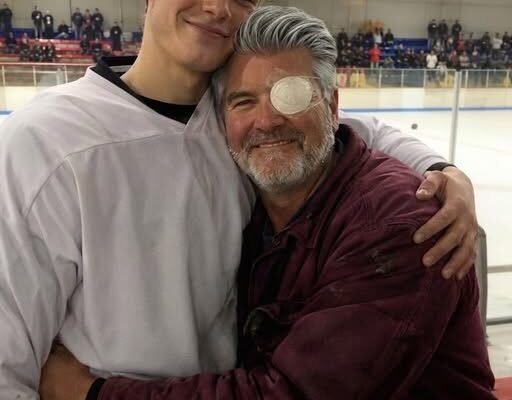
The last person I expected to see in the stands that night was a ghost from the past. As I watched my son skate onto the ice, I couldn’t shake the feeling that something much bigger than a championship game was about to happen.
The phone rang at 2 a.m. on a Tuesday in November, 14 years earlier.
I still remember the cold kitchen tile beneath my bare feet when I answered, and the way Danny’s voice broke before he could finish a sentence.
“Tom. She’s gone. Rachel’s gone.”
I gripped the receiver until my knuckles turned white.
Rachel, my best friend’s wife, was only 31.
An aneurysm, Danny told me.
No warning.
Their four-year-old son, Marcus, was asleep in the next room, probably expecting his mother to be there when he woke up for breakfast.
“I can’t do this, Tom. I can’t,” Danny kept saying.
“I’m so sorry, buddy. I’ll be there in the morning. Just hold on,” I told him.
I drove over the next morning and arrived around 7 with two cups of coffee and absolutely no plan.
I knocked.
No answer.
The door was unlocked.
The house was silent except for cartoons playing softly on the television.
Marcus was sitting on the rug in his pajamas, eating dry cereal from a plastic bowl.
Danny was gone.
On the kitchen counter, I found a note with four words:
“I’m not built for this.”
I was 28 years old.
Single.
A mechanic making $19 an hour.
I stood there holding that note while Marcus looked up at me.
“Where’s Daddy?”
Something inside me shifted.
Danny and Rachel didn’t have relatives who were willing to take Marcus, and I couldn’t imagine letting that little boy end up in foster care.
That morning, I made a decision.
I would become the best father to Marcus that I knew how to be.
The adoption took 11 months.
My lawyer, a kind woman named Patricia, charged me half her usual rate and told me I could pay whenever I was able.
Marcus moved into my one-bedroom apartment.
I learned how to trim his hair before school picture day in second grade.
I packed peanut butter sandwiches every morning for years.
I missed shifts because of fevers, school field trips, and the broken arm he got at the skating rink.
My boss probably would have fired me twice if Eddie hadn’t covered for me.
Eddie worked beside me at the garage, a wiry guy in his 50s who chewed sunflower seeds and rarely said much.
But whenever Marcus needed me, Eddie quietly took over my bays.
“Go to the kid’s recital, Tommy. I got this.”
“Eddie, I owe you.”
“You don’t owe me nothin’. Just go.”
Danny never called.
Not on Marcus’s birthdays.
Not at Christmas.
Not once.
Fourteen years passed like that.
Marcus grew into a tall kid with his mother’s eyes and a wicked shot that made grown men whistle from the stands.
By senior year, he was averaging 18 points a game, and half the trucks around town seemed to have stickers supporting his hockey team.
A week before the state championship, I watched Marcus grab his hockey bag from the kitchen chair.
I found myself thinking about Rachel and how proud she would’ve been of him.
“You good, Dad? You’re staring.”
He’d started calling me Dad when he was six.
“Just thinking,” I said.
He smiled.
But the smile didn’t quite reach his eyes.
Marcus had been different for a few months.
Quieter.
Always checking his phone.
Twice I’d walked into the living room and watched him quickly flip the screen face down against his thigh.
I told myself it was probably nothing.
A girl.
Senior-year drama.
Something teenagers didn’t want their fathers asking about.
But somewhere inside, I knew there was more to it.
The knock on my bedroom door came just after 11 a.m. the day before the championship.
By the time Marcus was 13, I’d finally managed to move us into a two-bedroom apartment.
“Dad, are you up?”
I sat against the headboard and switched on the lamp.
“Yeah, buddy. Come in.”
Marcus sat at the foot of my bed, exactly the way he used to when he was 11 and thunderstorms kept him awake.
He was 18 now.
Six-foot-two.
Still my kid.
“I’ve gotta tell you something. And I need you to hear me out before you say anything.”
My stomach tightened.
“Okay.”
He took a breath.
“I invited Danny to the championship tomorrow.”
For a moment, I couldn’t speak.
Danny’s name hadn’t been said in our home in probably a decade.
Hearing Marcus say it felt like somebody had suddenly switched on a light in a room I’d kept dark for years.
“He found me on Instagram three months ago,” Marcus explained quickly. “He kept messaging me. Stuff like, ‘I want to make it right, son.’ And, ‘Let me be there for the big moments.’ He says he’s changed. He’s married now to a woman named Cheryl. He got rich in commercial real estate.”
“Three months?”
My voice came out sharper than I intended.
“You’ve been talking to him for three months and didn’t tell me?”
Marcus looked down at the quilt.
“I kept trying. Every time I was going to say something at dinner, I chickened out. Then I figured if I waited any longer, you’d hear it from someone else, and that would be worse.”
I rubbed a hand across my face.
“What were you scared of?”
“That you’d think I was choosing him.”
The clock beside the bed read 11:14 a.m.
Puck drop was less than 18 hours away.
“Marcus, do you know what time he called me the night your mom died?”
“Dad.”
“Two in the morning. And when I got there, you were the only one left in that house.”
“I know the story.”
“Then you know what kind of man walks out on a four-year-old.”
Marcus finally looked at me.
His eyes were wet, but his jaw was set.
That was what got me.
He wasn’t backing down.
“Dad, please try to understand. I’m not asking you to like him. I’m asking you to trust me.”
Every part of me wanted to forbid it.
I wanted to tell Marcus that Danny didn’t get to disappear for 14 years and then show up at one of the most important moments of his son’s life pretending to be a father.
The words were already on my tongue.
Then I looked at Marcus sitting there.
I saw the same little boy I’d taught to tie his shoes on our kitchen floor.
And I knew that if I tried to control this decision, I might damage something between us that I could never repair.
“Okay,” I said.
He blinked.
“Okay?”
“You invited him. He’s coming. I’m not gonna make a scene.”
“Thank you.”
Marcus stood, then stopped at the doorway.
“Dad. I love you.”
“Love you too, kid. Get some sleep.”
He closed the door.
I stayed there beneath the lamplight for hours.
I didn’t sleep at all.
Instead, my mind replayed 14 years.
The emergency room visit when Marcus was six and split his chin open on the coffee table.
The science fair volcano that ruined our oven.
Every birthday.
Every Christmas.
Every parent-teacher conference where I sat alone in one of those tiny plastic chairs.
—
Around 5 a.m., I finally got out of bed and walked into the living room.
On the bookshelf sat a framed photograph of Marcus at five years old.
Gap-toothed.
Grinning.
Holding a plastic hockey stick almost as tall as he was.
I picked up the frame with both hands.
In a few hours, the man who had walked away from that little boy would walk back into his life.
The arena smelled of ice, popcorn, and cheap concession-stand coffee, the way it always did on big nights.
I’d been going to that building since Marcus was in fifth grade.
I knew nearly every row.
Then I saw Danny.
He walked inside wearing a navy suit that probably cost more than my truck, polished shoes, and a watch that flashed beneath the overhead lights.
He scanned the stands until he spotted me.
Then he headed straight toward the front row.
My row.
“Tom,” he said, sliding into the seat beside me as though 14 years had been nothing more than a long weekend. “Been a long time.”
I didn’t look at him.
I kept my eyes on Marcus warming up on the ice.
“Danny.”
He cleared his throat and adjusted his jacket cuff.
“I’m doing well now. Cheryl, my wife, has been good for me.”
He paused.
Then he said more quietly, “Marcus left the ticket at the gate. Said my seat was next to yours.”
“You picked a hell of a night.”
“Marcus invited me.”
That hurt because it was true.
A few minutes later, Eddie slid onto the bleacher behind me, smelling like the garage and the freezing air outside.
He had left work early to be there.
Like always.
He leaned toward my ear.
“Who’s the guy in the suit?”
“Marcus’s biological father,” I whispered.
Eddie went quiet.
Then he leaned forward again.
“Don’t let him rewrite the story, Tommy.”
I nodded.
My hands were trembling, so I locked them around my knees.
Then the referee dropped the puck.
Marcus played like he had something to prove.
Midway through the second period, he fired a shot past the goalie that sent the entire arena to its feet.
Danny jumped up applauding as if he’d been sitting in those stands for the last 14 years.
I stayed where I was, my throat tight.
By the third period, Marcus’s team was dominating.
First they led by four.
Then six.
With about 30 seconds remaining, Marcus carried the puck into the offensive zone and sent a perfect pass to his teammate Jalen.
Jalen buried it in the net.
The arena exploded.
When the final horn sounded, Marcus had scored twice, recorded two assists, and finished the playoffs with 10 points.
They’d won the state championship by six goals.
Once the celebration settled down, Coach Reeves skated to center ice carrying the Most Valuable Player trophy and a microphone.
He’d coached Marcus for three years.
“This year’s MVP,” Coach announced, “Marcus!”
The crowd rose as Marcus skated toward center ice.
Danny stood too, clasping his hands in front of himself like someone attending church.
Marcus accepted the microphone.
He looked down for a moment.
Then raised his eyes toward the stands.
“Tonight, sitting in this arena, is my real father,” Marcus said.
The arena went silent.
Eddie put a hand on my shoulder.
Danny straightened his jacket and lifted one hand slightly, almost like he was preparing to wave.
At some point, without realizing it, I’d left the bleachers and moved down beside the bench.
I was gripping the railing along the boards so tightly that my knuckles had turned white.
Marcus continued.
“We haven’t spoken in 14 years. He says he wants to rebuild our relationship. That’s why I invited him here tonight.”
There it was.
The thing I’d been afraid of since Marcus had sat on the end of my bed.
It felt like all the air had been knocked from my chest.
Danny’s mouth pulled into a small, practiced smile.
The kind of smile a man wears when he thinks the room is about to become his.
Then Marcus paused.
He slowly turned his head toward me.
The entire arena followed his gaze.
“That man over there, Danny, is the one who gave me life.”
He waited long enough for me to hear the rustling of people in the stands.
Then he continued.
“But my real father is the man standing by that bench in the same flannel he’s worn to every game since I was six. Tom.”
I stopped breathing.
“He’s the man who chose me when nobody made him. The man who taught me what showing up actually means.”
Marcus stepped off the ice.
Tears blurred my vision as he walked straight toward us.
Danny held out his hand.
Marcus passed him without slowing down.
Then my son stopped in front of me and placed the MVP trophy in my hands.
“This is yours, Dad,” he said quietly. “It always was.”
I couldn’t say anything.
Out of the corner of my eye, I saw Danny straighten his suit before slipping quickly toward the exit.
Nobody followed him.
Nobody tried to stop him.
Three weeks later, I was pouring cereal at the kitchen counter while Marcus zipped his duffel bag near the door.
The paperwork for his partial scholarship sat between us, already signed.
I finally had the words to ask about that night.
“You planned that speech, didn’t you?”
Marcus grinned around a spoonful of cereal.
“Eddie helped. I needed the whole town to hear it, Dad. Not just you.”
I shook my head.
“Why do it like that? Why invite Danny at all?”
“Because you’d never have let me say it any other way.”
I looked at him for a moment.
Then nodded.
—
The MVP trophy now sat on the shelf beside the framed adoption papers.
Two pieces of the same truth.
“Drive safely, kid,” I told Marcus.
“Love you, Dad.”
“I love you more, son.”
The door clicked shut behind him.
And standing there alone, I realized the little boy I’d raised had become exactly the kind of young man I’d always hoped he would be.