My Daughter Wasn’t Allowed to Sit at Our Dinner Table—Then I Came Home Three Days Early and Discovered What My Wife Had Been Hiding
“She should be thankful she has a roof over her head. If she wants dinner, she can eat standing by the counter. That chair belongs to someone who actually contributes to this family.”
Those were the words my daughter had been hearing in the house I worked sixty hours a week to provide.
I didn’t know about them until the night I returned from a business trip three days early.
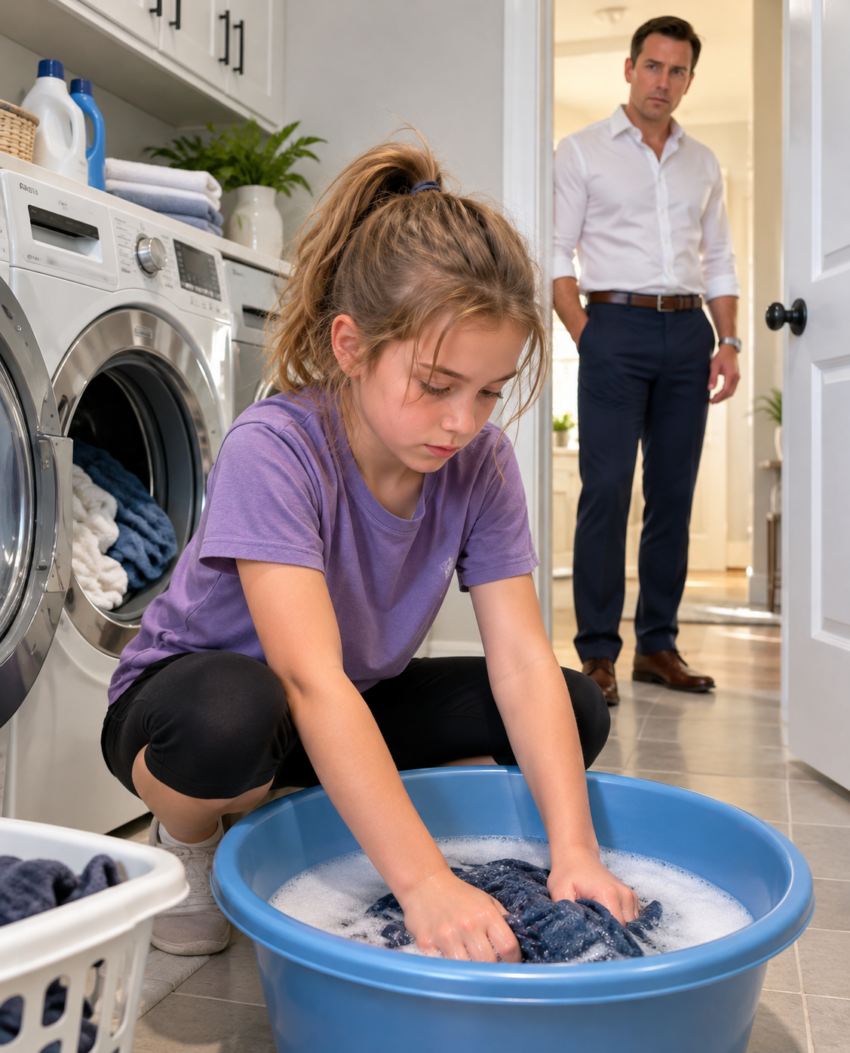
At 10:47 p.m., I found my sixteen-year-old daughter washing clothes by hand in a dark laundry room. Her stepmother had taken the rest of the family on vacation, leaving her behind with a list of chores.
When I asked why she wasn’t using the washing machine sitting three feet away, she whispered something that made my stomach turn.
“I’m not allowed to use it for my clothes, Dad.”
Then she tried to hide her arms beneath her sleeves.
I asked her to show me what she was hiding.
I didn’t raise my voice when I saw the marks. Instead, I took out my phone and began documenting what had happened.
But the discovery that changed everything wasn’t in the laundry room.
It was waiting inside my wife’s locked bedroom.
The House That No Longer Felt Like Home
My name is Nolan Mercer. I’m forty-four years old, and I’ve spent most of my adult life working as a regional freight supervisor based in Columbus, Ohio.
My job involves long drives, warehouse inspections, and occasional overnight trips across the Midwest.
I never loved being away from home, but after my first wife, Rebecca, passed away, I convinced myself that providing financial security was the best way to protect our daughter.
Our daughter, Tessa, was only eight when she lost her mother.
For years, it was just the two of us.
We made pancakes on Saturdays, watched baseball together, and kept a small photograph of Rebecca on the kitchen windowsill.
Then I met Vanessa.
She was warm, attentive, and especially kind to Tessa during the first year of our relationship.
When we married, I believed my daughter was gaining another adult who would love and protect her.
I couldn’t have been more mistaken.
That Thursday, a major shipment was delayed indefinitely. My supervisor told me there was no reason to remain in Indianapolis.
I decided to drive home without telling anyone.
I imagined surprising Vanessa and finding Tessa asleep upstairs, surrounded by textbooks and the stuffed animals she insisted she was too old to keep.
Instead, I pulled into a completely dark driveway.
Vanessa’s SUV was missing.
The front door was locked, and the kitchen looked unusually empty.
Then I heard water splashing somewhere behind the kitchen.
I followed the sound toward the laundry room.
There was Tessa, kneeling beside a plastic basin, scrubbing a pair of jeans with her bare hands.
Her hair was tied in a messy ponytail. Her sweatshirt looked several sizes too big, and her fingers were red from the cold water.
“Tessa?”
She turned so quickly that water spilled onto the floor.
“Dad? What are you doing here?”
She didn’t look excited.
She looked frightened.
“My trip ended early, sweetheart. Where’s Vanessa?”
Tessa stared at the basin.
“She went to Florida.”
“Florida? With whom?”
“Her mom, Aunt Denise, and Harper.”
Harper was Vanessa’s seventeen-year-old niece, who had moved into our house after her parents separated.
“They left you here alone?”
Tessa nodded.
“They said they’d be back Sunday.”
I looked at the washing machine.
It was running.
“Why aren’t you putting those jeans in there?”
She hesitated.
“That’s for their clothes.”
“And yours?”
“Vanessa says I use too much water and electricity.”
For a moment, I couldn’t find the words.
Then Tessa reached for another shirt, and her sleeve slipped upward.
I noticed several discolored marks on her forearm.
She immediately pulled the fabric down.
“Tessa, honey, can you show me your arms?”
“It’s nothing, Dad.”
“Please. I need to understand what’s been happening.”
Slowly, she pushed both sleeves toward her elbows.
There were several fading marks and scratches.
My chest tightened.
But I knew frightening her with my reaction wouldn’t help.
I knelt beside her.
“You don’t have to finish this laundry tonight. Go take a warm shower. I’ll make sure everything is okay.”
She looked toward the hallway.
“But Vanessa said everything has to be finished before Sunday.”
“Vanessa isn’t here. I am.”
For the first time that night, my daughter looked directly into my eyes.
The Breakfast That Revealed Everything
I barely slept.
After Tessa went upstairs, I photographed the laundry room, the basin, and the handwritten chore list taped to the wall.
Every item was assigned to Tessa.
Vacuum the entire house.
Wash the family laundry.
Clean Harper’s bedroom.
Scrub the bathrooms.
Prepare meals from whatever remained in the refrigerator.
At the bottom, Vanessa had written:
No television, no visitors, and no unnecessary phone calls.
I opened the refrigerator.
There were leftovers in several containers labeled with Vanessa’s name.
A smaller container on the bottom shelf held plain rice and vegetables.
A note attached to it read:
For Tessa. Make it last.
The next morning, I prepared blueberry pancakes.
Rebecca used to make them every Sunday.
When Tessa entered the kitchen, she stopped beside the counter instead of approaching the table.
“Breakfast is ready,” I told her.
“Should I eat over here?”
I turned around.
“Why would you eat over there?”
She looked embarrassed.
“Vanessa doesn’t like me sitting at the table when everyone else is eating.”
I pulled out her chair.
“This is your home, Tessa. You belong at this table as much as anyone.”
She sat slowly, almost as though she expected someone to tell her to get up.
I placed a plate in front of her.
“I need you to tell me what’s been happening while I’m away.”
At first, she insisted everything was fine.
Then I asked about the marks on her arms.
Her expression changed.
“Harper gets angry when I don’t do things the way she wants.”
“What kinds of things?”
“Cleaning her room. Letting her borrow my clothes. Doing her school assignments sometimes.”
She paused.
“Vanessa says I should be grateful they let me stay here.”
I felt a cold wave of disbelief.
“Tessa, this house belongs to us. I bought it before I married Vanessa.”
She looked up.
“That’s not what she told me.”
The Birthday My Daughter Watched Through a Window
As we talked, Tessa began describing things I had completely missed.
Vanessa had taken away her phone, claiming it was interfering with schoolwork.
She had answered calls from teachers and explained Tessa’s absences without telling me.
She had also told my daughter that complaining would only make my work trips more stressful.
But what hurt me most was what happened on Tessa’s sixteenth birthday.
I remembered calling home that evening.
Vanessa told me Tessa had a headache and had gone to bed early.
I sent a birthday message and promised we would celebrate when I returned.
Tessa stared at her pancakes.
“I wasn’t sleeping, Dad.”
“Where were you?”
“In the backyard.”
She explained that Vanessa had ordered a cake, decorated the dining room, and invited several guests.
But the celebration had been for Harper, who had received an early birthday party.
Tessa had been told to remain outside because there weren’t enough seats.
“I could see everyone through the window,” she said. “They sang happy birthday while Harper opened presents.”
I remembered paying for that cake.
Vanessa had told me it was a surprise for my daughter.
“Why didn’t you tell me?”
Tessa’s eyes filled.
“Because Vanessa said you’d think I was trying to ruin your marriage.”
I reached across the table and took her hand.
“Sweetheart, nothing you could tell me about being treated unfairly would ever make me stop loving you.”
She finally began to cry.
And I realized how long she’d been waiting to hear those words.
The Evidence I Almost Overlooked
That afternoon, I contacted Tessa’s school counselor.
With my daughter’s permission, we arranged a meeting and documented what she had described.
The counselor explained that teachers had noticed changes in Tessa’s behavior.
She had become unusually quiet, stopped participating in activities, and frequently appeared exhausted.
Several attempts to contact me had been redirected to Vanessa.
I also arranged for Tessa to receive a medical evaluation so the marks on her arms could be properly assessed and recorded.
Afterward, I asked my sister, Laurel, to stay with her while I returned home.
Laurel had always been close to Tessa.
When she heard what had happened, she didn’t ask unnecessary questions.
She simply hugged her niece and said, “You’re coming home with me for a little while, sweetheart. We’ll figure everything else out together.”
That evening, I returned to the house.
I needed to find Tessa’s phone, school records, and anything else Vanessa might have kept from me.
I checked the kitchen drawers and hallway cabinets.
Nothing.
Then I remembered something strange.
A few months earlier, Vanessa had installed a new lock on our bedroom door.
She claimed Harper sometimes borrowed her jewelry without asking.
At the time, I hadn’t questioned it.
Now I wondered what else she was keeping behind that door.
I called Vanessa.
“Hey, when are you getting home?”
She sounded cheerful.
“Sunday afternoon. Why?”
“I need something from the bedroom. Where’s the spare key?”
There was a pause.
“What do you need?”
“Some paperwork.”
“I’ll find it when I get back. Don’t worry about it.”
Then she changed the subject.
That was when I knew I needed to look more closely.
What Was Hidden in the Bedroom
I didn’t force the lock.
Instead, I contacted a locksmith and arranged to have the door opened after confirming my ownership of the house.
Inside, everything looked ordinary.
Vanessa’s clothes were neatly arranged. Her perfume bottles lined the dresser.
But one drawer contained a locked document box.
I recognized it.
It had belonged to Rebecca.
For years, I’d used it to store important family papers.
The key was still on my own key ring.
When I opened it, I found Tessa’s birth certificate, school documents, and several letters addressed to me.
There were also bank statements I had never seen.
Vanessa had opened a separate account into which she had transferred money from our joint household funds.
The amounts were substantial.
But the financial records weren’t the worst discovery.
Beneath them was a folder labeled Tessa — School.
Inside were printed emails from teachers expressing concern about her attendance and emotional well-being.
One message requested a meeting with her father.
Vanessa had replied from her own email account, claiming that I was aware of everything and didn’t wish to be contacted.
Another letter discussed Tessa’s application for an academic summer program.
She had been accepted.
Vanessa had declined the invitation without telling either of us.
I sat on the edge of the bed, holding the letter.
Tessa had spent months preparing for that opportunity.
She’d told me the program never responded.
And I’d believed it.
Then I found her phone.
It was powered off inside Vanessa’s nightstand.
When I charged it, Tessa helped me unlock it.
Several messages she’d drafted to me had never been sent.
One read:
Dad, I know you’re busy, but can you please come home? I don’t think I can keep doing this.
I read it three times.
I had been driving hundreds of miles to provide for my daughter while she was begging me to come back.
The Conversation I Finally Had With My Wife

I photographed the documents and preserved copies of the records.
Then I contacted an attorney.
I wanted to understand how to protect Tessa, secure her documents, and separate our finances without creating unnecessary conflict.
On Sunday afternoon, Vanessa returned home with Harper, Denise, and her mother.
They were laughing as they carried shopping bags through the front door.
The laughter stopped when they saw me sitting at the dining table.
“Nolan?” Vanessa asked. “I thought you weren’t coming back until Monday.”
“My trip ended early.”
Her eyes moved toward the stairs.