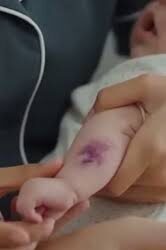
Lucy didn’t scream. She couldn’t. Her throat felt locked, as if fear had wrapped its fingers around her voice.
The word on Matthew’s arm read clearly now.
“HELP.”
Five simple letters. Clean. Precise. As if written by an adult hand.
Her first instinct was denial. She rubbed her eyes, blinked hard, even pinched her own arm. But the letters didn’t fade. They stayed, dark against his pale skin.
“Okay… okay,” she whispered, more to herself than to him. “You’re tired. You’re imagining things.”
Matthew didn’t cry. He didn’t babble. He just watched her. Quiet. Alert. Too alert.
Lucy stepped closer again, her heart pounding so loudly she was sure he could hear it. “Matthew?” she said softly, using the same sweet voice she always used. “Sweet boy?”
The baby’s lips twitched.
And then, in a voice that was low, calm, and absolutely not a baby’s voice, he spoke.
“They don’t hear me.”
Lucy’s knees nearly gave out. She grabbed the side of the crib to keep from falling.
“Who… who doesn’t?” she asked, her voice barely more than air.
“Them,” he replied, his eyes never leaving hers. “They don’t see what happens in the morning.”
Lucy backed away again. This was impossible. Babies didn’t talk. Eight-month-old babies didn’t form words, didn’t hold eye contact like that, didn’t sound… tired.
“You’re scared,” she whispered. “That’s all this is. I’m scared.”
Matthew frowned. An adult expression on a baby’s face. “You’re the first one who noticed.”
Her phone buzzed in her pocket. The sound made her jump. A message from Emily, Matthew’s mother.
Running late today. Everything okay?
Lucy stared at the screen, then back at the baby.
“Do they hurt you?” Lucy asked, forcing herself to say the words.
Matthew hesitated. Then nodded once.
“In the mornings,” he said. “When you’re not here yet.”
Lucy’s stomach turned. “Why don’t you cry?”
“I do,” he answered. “But they don’t listen.”
Tears filled Lucy’s eyes. She reached into the crib and gently touched his arm. The bruises were already starting to fade.
“What do you want me to do?” she asked.
“Don’t leave today,” Matthew said. “Stay and watch.”
That afternoon, Lucy didn’t go home. When Emily and Jason returned from work, she pretended everything was normal. She smiled, fed the baby, cleaned up, and stayed quiet.
But she watched.
Early the next morning, she hid in the hallway, her phone recording.
At 6:12 a.m., Jason entered the nursery alone. His face was cold, irritated. He grabbed Matthew too roughly, muttering under his breath about sleepless nights and “a kid who never shuts up.”
Lucy felt sick as she watched Jason grip the baby’s arms, shaking him just enough to leave marks, not enough to be obvious.
When Jason left, Lucy stepped into the room, shaking with anger.
She called the police before breakfast.
By noon, Jason was in handcuffs. The video was clear. The photos from weeks before matched perfectly.
Emily collapsed into a chair, sobbing, repeating the same words over and over: “I didn’t know. I swear I didn’t know.”
Matthew’s bruises never appeared again.
A week later, Lucy visited him one last time before he went to live with Emily’s sister. He was back to being a normal baby—crying, giggling, reaching for her hair.
As she leaned over the crib, she noticed something faint on his arm.
Not bruises.
Just skin.
Matthew smiled, babbled softly, and for the first time, looked exactly like an eight-month-old baby should.
Lucy walked away knowing one thing for sure.
Some signs disappear by afternoon.
Others only disappear once someone finally dares to look.