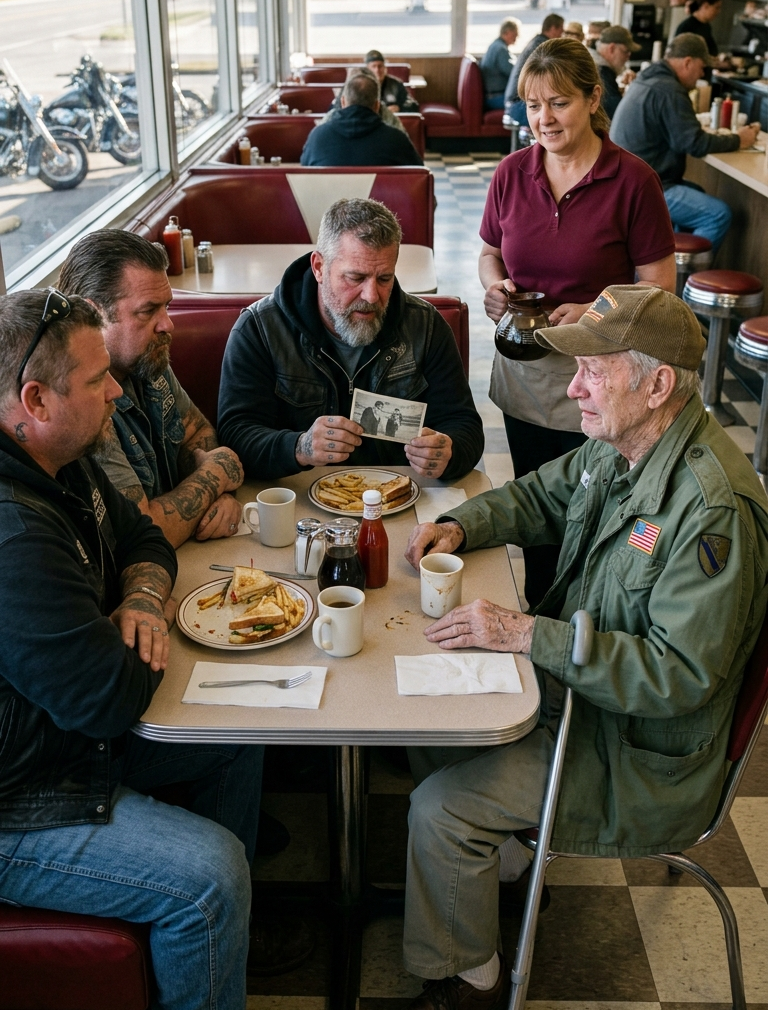
The Quiet Hour at Laurel Pine Diner
The slow hour between lunch and dinner had always been Wade Harlan’s favorite time of day.
By then, the clatter had faded. The families were gone, the office crowd had already rushed back to their jobs, and the booths at Laurel Pine Diner sat in a kind of tired stillness that suited him better than noise ever could. It was late autumn in western North Carolina, and the pale sun stretched across the highway in long golden bands that made everything outside look warmer than it really was. The air still held that mountain chill that slipped through denim, leather, and old scars alike.
Wade stepped through the diner door with five men behind him, broad-shouldered and road-worn, each carrying the quiet presence of someone who had seen enough of life to stop trying to impress anybody. Their boots thudded against the old tile floor. A few people glanced up and then quickly looked away.
That part never surprised Wade.
He had lived long enough to know what people saw when they looked at men like him. The gray in his beard, the heavy leather vest, the old club patch, the expression that never tried too hard to seem friendly—those things told a story before he ever opened his mouth. Most folks decided what kind of man he was from across the room.
He didn’t argue with strangers anymore.
He led his brothers to the biggest booth along the back wall, the one that gave him a clear view of the front door. He always sat facing the entrance. Old habits had a way of becoming permanent after enough years. As he slid into the cracked vinyl seat, June, the diner’s longtime waitress, was already walking toward them with a coffee pot in hand.
She knew them well enough not to put on a fake smile.
“The usual?” she asked.
Wade gave a small nod. So did the others.
June filled their mugs without asking how their ride had been or where they’d come from. She didn’t make conversation unless it came naturally, and Wade respected that. In a world full of people who talked too much, she had learned the value of leaving things alone.
Across from Wade, Boone Mercer stretched his back and groaned. “I swear,” he muttered, rubbing both hands over his face, “if my little boy climbs into my bed one more night and kicks me in the ribs, I’m filing a formal complaint against parenthood.”
That drew a low laugh from the table.
Leon Shaw, who always looked half amused and half annoyed by life in general, took a sip of coffee and said, “He’s five. You’re supposed to be tougher than that.”
Boone frowned. “You try reasoning with a five-year-old at two in the morning.”
“I’m not saying I’d win,” Leon said. “I’m saying I’d at least make it a fight.”
Even Wade smiled at that.
For a few minutes, the booth filled with easy talk and familiar teasing. It was the kind of conversation that came from years of shared miles, shared losses, shared silence. None of them needed to perform for the others. That was rare. And valuable.
Then the bell above the front door rang.
Wade looked up automatically.
The man who stepped inside wasn’t a threat. He was thin, elderly, and moving with the careful effort of someone who had learned not to trust his own balance. He leaned on a cane that had been used so long the handle had gone smooth with wear. His jacket was faded army green, and pinned to it was a small American flag that caught the light when he turned.
He paused just inside the doorway and looked around the diner, but not the way hungry people usually did. There was no casual searching in his eyes. No simple decision about where to sit. It looked more like he was trying to decide whether he was welcome in the room at all.
Something in Wade’s chest tightened.
A teenage hostess led the man to a little table by the front window. It was one of the least comfortable spots in the place, close to the glass, close to the draft, close to the parking lot where strangers could look in and see you sitting there alone. The old man eased himself down carefully, set his cane against the table, folded his hands, and stared out toward the road.
He didn’t open the menu.
A Request No One Expected

Their food arrived, and the men at Wade’s table started eating. The noise of forks, plates, and soft country music filled the room. Boone drowned his fries in hot sauce while Leon complained about the smell. Two of the others argued quietly about carburetors.
But Wade kept glancing toward the window.
The old man still hadn’t ordered.
June had gone by his table once. Wade noticed the short exchange, the polite shake of the old man’s head, and the way June had walked away slower than usual, as if she didn’t quite know what to do with what she’d seen.
There was a loneliness around that man that seemed bigger than the diner itself.
Not the ordinary kind. Not the kind that came from a quiet afternoon or a missed phone call. This was deeper than that. It settled around him like weather that had been building for years.
A few minutes later, the man pushed himself slowly to his feet.
Wade expected him to head for the restroom or maybe the counter. Instead, he turned and began walking toward their booth.
Conversation at the table stopped.
The brothers watched him approach with the alert stillness of men who had spent too many years reading intentions before words were spoken. But when the old man reached the edge of their booth, there was nothing threatening about him. Just nerves. And something close to shame.
He looked at Wade first.
His voice came out dry and unsteady.
“Would one of you mind having lunch with me?”
The question was so simple that for a second nobody answered at all.
Wade had faced anger, disrespect, panic, grief, and pride in all kinds of places. But pure vulnerability like that—an old man standing in front of six intimidating bikers and asking, as gently as he could, not to be alone—had a way of reaching past defense and landing somewhere deeper.
Wade set down his sandwich.
He pushed out the chair at the end of the booth with one heavy boot and said, “You don’t have to ask twice. Sit with us.”
The old man’s face changed in a way Wade would never forget. Relief moved through it so quickly it was almost painful to witness, as if he had prepared himself for rejection and still could not believe kindness had arrived instead.
He sat carefully, both hands resting on top of the cane.
Boone signaled June before the man could protest.
“Bring him whatever he wants,” Boone said. “And a fresh pot of coffee.”
The old man started to shake his head. “I don’t have enough on me for—”
Leon cut in gently. “Then it’s a good thing you’re not paying.”
For the first time, the old man gave a faint, uncertain smile.
The Man by the Window
When the food came, he looked at it for a long moment before touching the fork. Wade had seen hungry people before. This was not that. This was a man who had forgotten what it felt like to be cared for in plain sight.
“My name is Everett Calloway,” he said at last. His voice was soft, but steadier now. “I hope I’m not imposing. I just… I sat over there for a while, and the silence got too loud.”
Wade leaned his forearms on the table. “You’re not imposing, Everett. Everybody needs company sometimes.”
Everett nodded once, eyes lowered.