The Seven-Year-Old Boy Asked a Male Police Officer to Walk Him Home—“Please Look at My Room Before You Believe My Dad.” What the Officer Found Explained Why the Child Had Practiced Those Words for Three Days
The Little Boy Who Had Rehearsed His Request
“Officer Bennett, could you please walk home with me today? And if my dad tells you everything is fine, will you look at my room before you believe him?”
I had worked with children long enough to recognize when something was troubling them. But I had never heard a seven-year-old make a request quite like that.
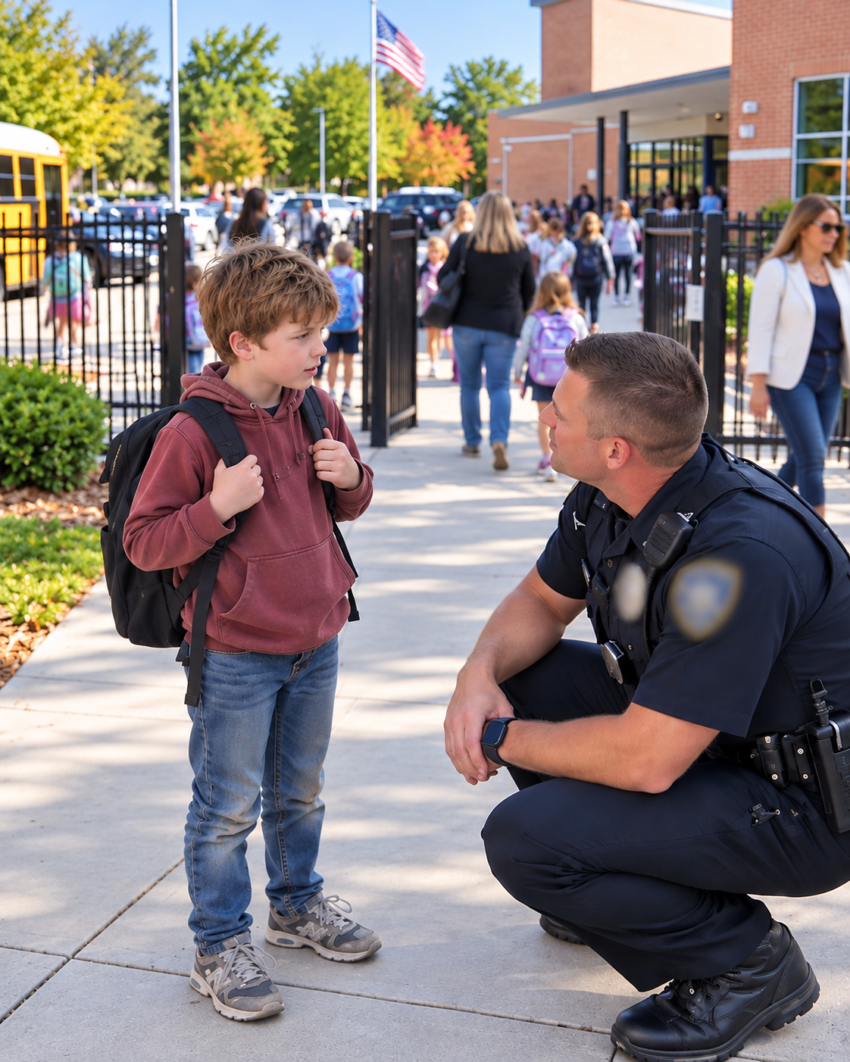
The boy standing in front of me was small for his age. His blue backpack looked almost too heavy for his narrow shoulders, and the toes of his sneakers were worn thin.
What caught my attention, however, was the careful way he spoke.
He wasn’t crying or trying to attract attention. He looked like someone who had spent a long time deciding exactly what to say.
My name is Caleb Bennett. At the time, I was forty-two years old and had spent nearly five years working as a school resource officer in Longmont, Colorado.
That November afternoon, I was stationed outside Pine Ridge Elementary School, helping supervise dismissal.
Parents were pulling into the pickup lane. Teachers were reminding children to zip their jackets against the cold. A few students waved at me as they hurried toward waiting cars.
Then this little boy approached.
“You’re Officer Bennett, right?”
“That’s me, buddy. What’s your name?”
“Owen Mercer.”
I smiled.
“Nice to meet you, Owen. Did you miss your ride?”
He shook his head.
“I walk home. It’s only a few blocks.”
“Then what can I help you with?”
He glanced toward the school entrance, making sure nobody was listening.
“I need you to see something. Because when I tell people about it, my dad always explains it, and then they leave.”
I stopped smiling.
“What do you need me to see?”
Owen looked down at his shoes.
“I can’t explain it as good as he can. But maybe if you see it yourself, you’ll understand.”
I lowered myself to his eye level.
“Owen, is there something happening at home that’s making you feel unsafe?”
He hesitated before answering.
“I don’t know how to say it right.”
Then he looked directly into my eyes.
“That’s why I practiced asking you.”
I didn’t know it yet, but those words would stay with me for years.
The Walk That Wasn’t Part of My Schedule

Before leaving school property, I notified the front office and contacted my supervisor over the radio.
I explained that a student had approached me with concerns about his home environment and that I intended to accompany him while gathering more information.
The school secretary confirmed that Owen was normally permitted to walk home.
Once the necessary arrangements were made, we started down the sidewalk together.
It was early November, and the Colorado air had already turned cold. Dry leaves gathered along the curbs, and several houses had pumpkins sitting beside their front doors.
Owen walked beside me with both hands wrapped tightly around his backpack straps.
For the first block, neither of us said much.
Then I asked whether he had ever spoken to someone about his concerns before.
“My teacher,” he answered.
“What happened when you told her?”
“She listened. Then some people came to our house.”
“Do you remember who they were?”
“A lady with a folder. And a man.”
He kicked a small stone across the sidewalk.
“Dad talked to them outside. He said we were having a hard month and that everything would be fixed soon.”
“And was it?”
Owen shook his head.
“No, sir.”
I waited, giving him time to continue.
“After they left, Dad said grown-ups understand things better than kids do. He told me I shouldn’t make people worry about stuff they don’t understand.”
His voice grew quieter.
“So I tried not to say anything anymore.”
I knew there could be several explanations for what he was describing. Financial hardship, family stress, and household repairs did not automatically mean a child was being neglected.
But Owen wasn’t asking me to judge his father.
He was asking me to look.
As we approached the next intersection, I asked another question.
“Why did you choose me?”
He thought about it.
“Because you’re always at school, and you talk to kids even when they aren’t in trouble.”
I felt something tighten in my chest.
“And you thought I’d listen?”
He nodded.
“I hoped you would.”
The House With Every Curtain Closed

After walking five blocks, Owen stopped in front of a modest single-story house.
It sat between two well-maintained homes on a quiet residential street.
There was nothing particularly unusual about the building itself. The siding needed cleaning, and the grass was longer than the neighboring lawns, but plenty of families struggled to keep up with household maintenance.
What struck me was the absence of anything that suggested a young child lived there.
No bicycle leaned against the garage.
No basketball rested near the porch.
There were no toys, sidewalk drawings, or little boots by the front door.
Every curtain was closed, even though it was still afternoon.
Owen reached into his backpack and pulled out a house key.
His fingers trembled slightly.
Then he stopped.
“Officer Bennett?”
“Yes?”
“Can I ask you one more thing?”
“Of course.”
He looked at the house before turning back to me.
“If my dad tells you everything is fine, will you please look at my room before you believe him?”
I studied his face.
“I’ll listen to what everyone has to say, Owen. And I’ll pay attention to what I can actually see.”
He nodded slowly.
“Okay.”
Before he could unlock the door, footsteps sounded inside.
A man opened it.
He appeared to be in his early forties, with tired eyes, dark hair, and a faded gray sweatshirt.
His expression changed immediately when he noticed my uniform.
“Officer? Is something wrong?”
I kept my tone calm.
“Good afternoon. I’m Officer Bennett, the school resource officer at Pine Ridge Elementary. Your son asked me to walk home with him. He mentioned some concerns about the house.”
The man’s eyes moved toward Owen.
“What concerns?”
“I’d like to speak with you about them. Would you mind if we stepped inside?”
He hesitated.
Then he sighed.
“Fine. But I can explain everything.”
His name was Russell Mercer.
And as I would soon discover, he really did have an explanation for almost everything.
A Father Who Had an Answer for Every Question
The living room was noticeably colder than the air inside most occupied homes.
The curtains were tightly closed, and a small portable heater stood beside the couch.
Russell noticed me looking at it.
“The furnace has been acting up. I’ve been trying to get someone out here to fix it.”
I nodded.
“How long has it been having problems?”
“A few weeks. Money’s been tight.”
He explained that his hours at work had recently been reduced and that he was behind on several bills.
There were unfolded clothes on the couch, dishes in the kitchen sink, and unopened mail covering part of the dining table.
None of those things alone proved anything about how Owen was being cared for.
Russell continued speaking.
“I’m raising him by myself. His mother isn’t around, and I’m doing the best I can. The house isn’t perfect, but he’s got a roof over his head.”
I listened carefully.
Then I asked whether Owen had a warm place to sleep.
“Of course he does.”
Owen stood quietly near the hallway.
His father looked toward him.
“Tell the officer you’re fine, son.”
The boy didn’t answer.
I gently redirected the conversation.
“Mr. Mercer, would you be comfortable showing me Owen’s bedroom?”
Russell rubbed his forehead.
“Sure. It’s messy, but kids’ rooms usually are.”
He led me down the hallway.
Owen followed several steps behind us.
When we reached the bedroom door, Russell pushed it open.
And for the first time that afternoon, he stopped talking.
The Bedroom Owen Wanted Me to See
The room was small, with a single window and pale blue walls.
There was a narrow bed against one side, a wooden dresser, and a shelf holding a few schoolbooks.
The air felt colder than it had in the living room.
I noticed the bed immediately.
A thin blanket lay across a bare mattress. There was no comforter, and the pillow had no pillowcase.
On the floor beside the bed sat a pair of socks and a sweatshirt that looked too small for Owen.
Russell cleared his throat.
“Laundry’s behind. I was going to get everything washed this weekend.”
I didn’t respond immediately.
Instead, I asked about the temperature.
“Does the furnace heat this room?”
“Not properly right now. That’s why I keep the portable heater in the living room.”
I looked toward Owen.
“Where do you sleep when it gets really cold?”
He glanced at his father.
Russell answered first.
“Sometimes he sleeps on the couch. It’s warmer out there.”
Owen looked down.
I asked him gently whether he could tell me in his own words.
“Sometimes I sleep on the couch,” he said. “But Dad stays up watching television, so I usually go back to my room.”
“Do you have another blanket?”
He shook his head.
“I had a big one, but it got wet a while ago. Dad said we’d get another.”
Russell spoke again.
“I’ve been working on it. Things have just been difficult lately.”
I believed that his circumstances might genuinely be difficult.
But hardship and a child’s unmet needs were two different matters.
I noticed a small notebook beside the bed.
Its cover featured a colorful rocket ship.
Owen picked it up.
“That’s my science notebook,” he explained.
I smiled slightly.
“You like science?”
He nodded.
“I want to build airplanes someday.”
Then he placed the notebook back on the dresser and looked at me.
“Do you see what I meant now?”
There was something deeply unsettling about how carefully he asked.
He wasn’t demanding that I take his side.
He simply wanted to know whether I had noticed.
“Yes, Owen,” I answered. “I see why you’re worried.”
His shoulders relaxed a little.
It was the first time I had seen him look even slightly relieved.
The Details That Could No Longer Be Explained Separately
With Russell’s permission, I continued speaking with him about the household conditions.
The refrigerator contained some food, but there were limited ready-to-eat options for a child Owen’s age.
Russell explained that he usually prepared dinner after work.
Owen quietly mentioned that his father sometimes came home late.
The heating problem had continued for weeks.
Several of Owen’s clothes no longer fit properly.
His bedding had not been replaced.
And his school had already expressed concerns.
Each issue had an explanation.
But together, they raised questions that deserved professional attention.
I stepped into the hallway and contacted my supervisor.
I explained what I had observed and requested assistance from the local child protection agency for an urgent assessment.
Russell grew frustrated when he realized I was making the call.
“You’re making this sound worse than it is.”
“I’m documenting what I’ve seen, Mr. Mercer. The appropriate professionals will review the situation.”
“I told you I’m trying to fix things.”
“I understand that’s what you’re telling me.”
He looked toward the bedroom.
“I’m not a bad father.”
I didn’t argue with him.
My responsibility wasn’t to decide what kind of person Russell was based on one afternoon.
It was to make sure Owen’s circumstances were properly evaluated.
While we waited, I asked Russell if I could speak with his son on the porch.
He agreed.
Owen followed me outside.
“You’re Still Here”
We sat on the front steps.
Across the street, a woman was walking a golden retriever. Somewhere nearby, someone was using a leaf blower.
The neighborhood continued with its ordinary afternoon.
Owen sat beside me, his hands folded between his knees.
For several minutes, he said nothing.
Then he looked up.
“You’re still here.”
I turned toward him.
“I am.”
He nodded as though he needed a moment to understand that.
“The other people left pretty fast.”
“I’m going to stay until we know what happens next.”
He looked toward the driveway.
“Do you believe me?”
“I believe that you’ve been trying to tell people something important.”
He considered my answer.
“Even though Dad can explain everything?”
“An explanation doesn’t mean we should stop asking questions, Owen.”
He rubbed his hands together.
Then he said something I hadn’t expected.
“I practiced for three days.”
“Practiced what?”
“Asking you to come home with me.”
I looked at him.
“Three days?”
He nodded.
“I tried saying it different ways when I was alone. I didn’t want you to think I was just complaining.”
He paused.
“Then I thought maybe I shouldn’t ask you to believe me. Maybe I should just ask you to see it.”
For a moment, I couldn’t find the right words.
Here was a seven-year-old child who had spent three afternoons rehearsing a conversation with a police officer because he was afraid another adult might dismiss his concerns.
Finally, I said:
“Owen, you did the right thing by speaking up.”
He looked at me carefully.
“Even if Dad gets upset?”
“It’s okay to tell a trusted adult when something at home doesn’t feel right.”
He lowered his eyes.
“I just wanted somebody to understand.”
The Decision That Changed His Evening
My supervisor arrived, followed later by a child protection caseworker from Boulder County.
The caseworker spoke with Russell and Owen separately, reviewed the household conditions, and made additional calls.
I remained nearby while the assessment continued.
The caseworker explained to Russell that the immediate concerns included the lack of adequate heating in Owen’s bedroom and the need for a reliable plan to meet his daily needs.
Russell initially resisted the idea of Owen staying elsewhere.
“He’s my son. I can take care of him.”
The caseworker acknowledged his concerns and discussed available options.
Eventually, they agreed on a temporary safety plan while the agency completed its review and Russell worked on the household problems.
Owen could stay with a trusted relative who was able to provide a warm, stable environment.
There was one person he had mentioned during the assessment.
His mother’s older sister.
Her name was Marissa Cole.
She lived about thirty minutes away in the Loveland area.
After speaking with Marissa and completing the initial checks required for the temporary arrangement, the caseworker confirmed that she could come for Owen.
I was sitting beside him when he asked the question he had apparently been holding back all afternoon.
“Am I going to have to sleep here tonight?”
I looked toward the caseworker.
She gave a reassuring nod.
“No, buddy,” I said. “Your Aunt Marissa is coming to get you.”
Owen stared at me.
“Really?”
“Really.”
He didn’t jump up or start cheering.
He simply closed his eyes for a moment.
Then he leaned slightly against my arm.
It was such a small movement that someone watching from across the street might not have noticed.
But I did.
The Aunt Who Hadn’t Understood
Marissa arrived wearing navy work pants and a cream-colored cardigan.
She was thirty-six and had come directly from the medical office where she worked.
When Owen saw her car pull into the driveway, he stood so quickly that his backpack slipped from his shoulder.
“Aunt Marissa!”
She hurried toward him.
“Oh, sweetheart.”
She knelt and wrapped her arms around him.
Owen held on without saying anything.
For a long moment, neither of them moved.
Later, while the caseworker finished discussing the temporary arrangements, Marissa approached me.
Her eyes were damp.
“He called me a few months ago,” she said.
I listened.
“He told me things weren’t good at home. I knew Russell was having money problems, and I thought Owen was talking about arguments or bills.”
She looked toward her nephew.
“I told him to talk to his teacher because I thought the school could help.”
“He did speak to someone at school,” I explained.
Marissa nodded slowly.
“And they reported it?”
“There was an earlier report and a response. I can’t speak for every decision made then, but today’s observations have been documented for a new assessment.”
She pressed her fingers against her forehead.
“I should have gone to see him myself.”
I didn’t offer an easy answer.
She had misunderstood what Owen was trying to tell her, but she was here now.
After a moment, she asked:
“Why did he choose you?”
I glanced toward the little boy standing beside the caseworker.
“He told me he’d been watching me at school. I think he wanted to make sure I’d listen.”
Marissa looked confused.
“Watching you?”
“He practiced asking me for three days.”
She covered her mouth.
“Three days?”
I nodded.
Her eyes filled again.
“He’s seven years old. He shouldn’t have had to figure all of that out.”
I couldn’t disagree.
Six Months Later, a Photograph Arrived
The following months involved decisions made by family members and child protection professionals.
Russell was given an opportunity to address the concerns in his home, while Owen’s longer-term living arrangements were reviewed.
For the time being, Owen remained with Marissa.
I wasn’t involved in every stage of the process, and I didn’t know all the private details.
But six months after that November afternoon, an envelope arrived at the police station.
My name was written neatly across the front.
Inside was a photograph.
At first, I barely recognized the boy in it.
Owen was standing on a soccer field, wearing a bright green jersey. His cheeks were flushed, his hair had grown longer, and he was smiling with his entire face.
His knees were covered in grass stains.
He looked like a child who had spent the afternoon running around with friends instead of worrying about what waited for him at home.
Marissa had included a note.
Owen was doing well in school.
He had made two close friends.
His favorite subject was science, and he had started building model airplanes from inexpensive kits.
He was also playing on a local youth soccer team.
At the bottom of the letter, Marissa had written something that made me sit quietly for several minutes.
He still asks adults whether they promise to listen before he tells them something important. I’m hoping that, with time, he’ll learn he doesn’t always have to ask.
I placed the photograph on my desk.
Every time I looked at it, I remembered the little boy standing outside Pine Ridge Elementary with his hands gripping his backpack straps.
And I remembered how carefully he had chosen his words.
The Day He Came Back to See Me
Almost a year after our first meeting, Pine Ridge Elementary hosted a community safety event.
I had been invited to speak with students and parents about school safety.
Marissa brought Owen back to visit one of his former teachers.
I was standing near a display table when I heard someone call my name.
“Officer Bennett!”
I turned.
A boy in a blue jacket was running toward me.
It took me a second to recognize him.
“Owen?”
He grinned.
“You remembered!”
“Of course I remembered.”
Marissa approached behind him, smiling.
Owen immediately began telling me about his soccer team, his new school, and a model airplane he had built with Marissa’s help.
He talked so quickly that I could barely keep up.
For several minutes, he sounded like any other excited eight-year-old.
Then his expression became thoughtful.
“Officer Bennett, do you remember when I asked you to walk home with me?”
“I remember it very well.”
He looked down briefly.
“I was really scared that day.”
“I know, buddy.”
He nodded.
“I thought you might leave, too.”
I felt the same tightness in my chest that I had felt on his front steps a year earlier.
“I’m glad I stayed.”
Owen looked up and smiled.
“Me too.”
Then Marissa called him over to say hello to his former teacher.
He waved and ran toward her.
I watched him go, thinking about how different he seemed from the child I had first met.
He was still careful about whom he trusted.
But now he also had room in his life for soccer games, science projects, friendships, and ordinary childhood worries.
That was what I had hoped for him.
What a Seven-Year-Old Taught Me About Listening
During my years in law enforcement, I had learned that important moments rarely announce themselves.
Sometimes they happen during an ordinary afternoon when a child asks a question you weren’t expecting.
Owen didn’t ask me to solve every problem in his family.
He didn’t demand that I make promises I couldn’t keep.
He simply asked me to walk beside him for five blocks and look at something he had struggled to explain.
His father had an answer for the broken furnace.
An answer for the missing bedding.
An answer for the clothing, the food, and the conditions inside the house.
Some of those explanations may have been sincere.
But Owen needed more than explanations.
He needed adults who could recognize that a child’s daily needs still mattered, even when a family was facing difficult circumstances.
I also learned something about the courage it takes to ask for help after earlier attempts haven’t brought the changes someone needs.
Owen had tried speaking to adults before.
When he felt unheard, he didn’t know what else to do.
So he spent three days practicing a different request.
He decided that instead of asking someone to believe his words, he would ask someone to see his world.
I have never forgotten that.
Because sometimes the most important thing we can do for another person is not to offer an immediate solution or make a grand promise.
Sometimes it is simply to listen long enough to understand what they have been trying to tell us.
And when a child quietly asks, “You’re still here?”, perhaps the most meaningful answer we can give is to remain present while the people who can help begin doing their work.
10 Messages to Remember
1. Sometimes the greatest courage comes from the smallest person in the room, especially when a child has spent days rehearsing a simple request because previous attempts to explain his feelings have left him believing that nobody truly understands.
2. When someone repeatedly tells us that something in their life doesn’t feel right, we should remember that listening means more than hearing their words; it means taking the time to understand the circumstances behind those words.
3. A parent may be facing genuine financial difficulties and still need help meeting a child’s everyday needs, because compassion for struggling adults and concern for children’s well-being should never be treated as opposing responsibilities.
4. Children don’t always know how to describe complicated family situations, but their uncertainty should never be mistaken for a lack of understanding, especially when they are trying to communicate something important about their own lives.
5. One reasonable explanation may account for a broken appliance or an untidy room, but when several concerns appear together, responsible adults must consider the complete situation rather than dismissing each detail separately.
6. Trust is often rebuilt through small, consistent actions rather than dramatic promises, and sometimes remaining beside a frightened child while responsible professionals arrange help can mean more than any carefully prepared speech.
7. We should never underestimate how closely children observe the adults around them, because a simple act of kindness at school may be remembered by a child who is quietly searching for someone trustworthy enough to approach.
8. Helping a family doesn’t always require choosing someone to blame, because meaningful support can involve recognizing unmet needs, providing immediate assistance, and giving adults a fair opportunity to create a safer and more stable home.
9. A child deserves the freedom to think about friendships, sports, school projects, and future dreams without carrying the responsibility of convincing adults that his everyday needs deserve attention and care.
10. If someone finds the courage to ask us to look beyond an easy explanation, we should respond with patience, fairness, and genuine attention, because being heard at the right moment can become the beginning of a much brighter chapter in that person’s life.