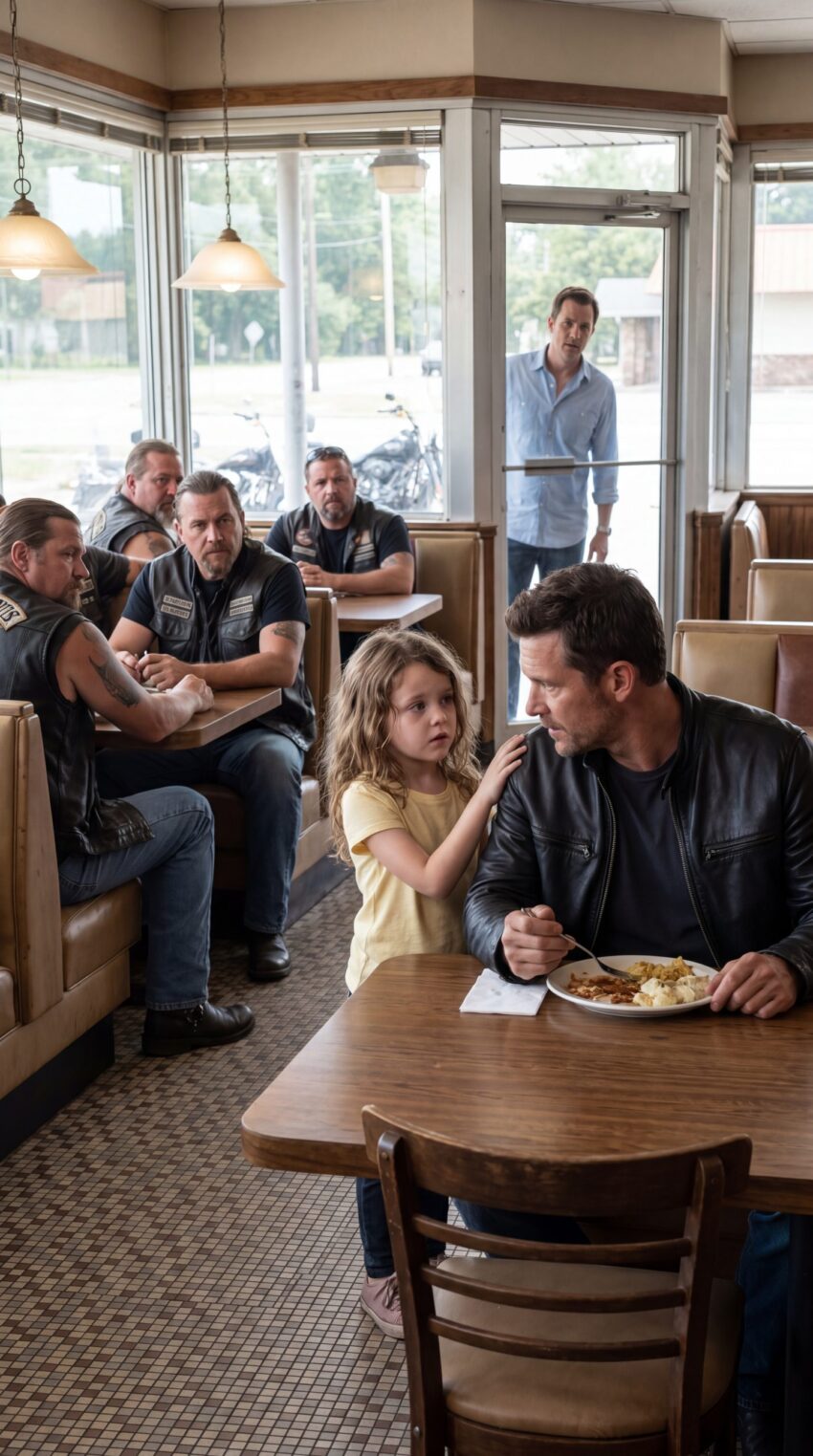
The Girl in the Corner Booth
By the time I noticed her, the lunch rush had already begun to thin out.
The diner sat just off Route 81 outside a small town in western Oklahoma, the kind of place where truckers, ranch hands, and road-worn riders all ended up sooner or later. The coffee was strong, the pie was better than it had any right to be, and nothing much ever happened there that the whole room didn’t notice.
That morning felt ordinary until a little girl slipped through the front door and stood near the pie case like she wasn’t sure whether she was allowed to take up space.
She looked about seven, maybe eight. Thin shoulders. Dust on her sneakers. Hair chopped unevenly, as if someone had cut it in a hurry with the wrong scissors. She wasn’t crying. That was what unsettled me first. Kids that age usually cried when they were scared. This one had gone beyond that. She was quiet in the way only a frightened child could be.
I was halfway through my eggs when she glanced toward our booth.
We were six riders from the Iron Hollow Riders, passing through after a memorial ride near Elk Ridge. Leather vests, heavy boots, scarred hands, faces the world liked to judge before it asked questions. Most people stared at us for a second and then looked away. The little girl kept looking.
Then she walked straight toward me.
She stopped beside the booth, fingers curling into the cracked vinyl seat, and said in a voice so low I nearly missed it, “Can I sit here for one minute?”
Every sound in the diner seemed to soften.
I looked at the empty space across from me and nodded. “Yeah, sweetheart. You can sit here as long as you need.”
She climbed in carefully, like even that much movement cost her courage.
Rhett Mercer, who was sitting beside me, set down his fork. He had a beard gone silver at the chin and the kind of stillness that made other men think twice. He didn’t say anything at first. He just watched the front of the diner through the reflection in the window.
The waitress, Connie, came over with her coffee pot and took one look at the girl’s face before her own expression changed. “Honey, you want some water?”
The girl nodded once.
When Connie walked away, I leaned forward, trying not to crowd her. “What’s your name?”
She swallowed. Her lips trembled before the answer came out.
“Mara.”
It was barely more than air.
Before I could say another word, the bell over the diner door rang again.
A man in a gray jacket stepped inside and turned slowly, scanning the room. Late thirties. Clean boots, though the rest of him looked worn out. Sweat at his temples. Jaw tight. Eyes moving too fast. He wasn’t searching like a worried father. He was searching like a man trying to recover something before anyone asked the wrong question.
And the moment his gaze landed on our booth, Mara flinched so hard her shoulder hit the wall.
That was all I needed.
The Smile That Didn’t Reach His Eyes
The man started walking toward us with a smile that felt practiced.
“There you are,” he said brightly. “You had me worried. Come on, pumpkin. Time to go.”
Mara didn’t move.
Rhett leaned back slowly, one arm over the top of the booth. “She doesn’t look ready to leave.”
The man’s smile faltered for half a second. Then it returned, thinner this time. “She’s shy. Been a rough morning.”
I looked at the girl. “Is that your dad?”
Her answer came so softly I almost wished I hadn’t heard it.
“No.”
The room changed after that.
Not loudly. Not all at once. But table by table, chair by chair, people began to notice what was happening. The cook stopped rattling pans in the back. Two older farmers at the counter turned on their stools. Connie set down the coffee pot without taking her eyes off the man.
He laughed, but there was no ease in it. “Kids say strange things when they’re upset.”
Mara’s hand found the edge of my vest and held on.
I met his stare. “She said no.”
His face lost the last of its warmth. “You don’t know the situation.”
Rhett stood up.
He didn’t raise his voice. He didn’t step close. He just stood, broad and steady, and the aisle suddenly felt much smaller.
“Then explain it from where you are,” Rhett said.
The man’s eyes darted toward the exit, then toward the side hallway by the restrooms. He was measuring distance. Openings. Chances. That told me more than any words he could have chosen.
I crouched beside Mara so I was level with her. “Sweetheart, tell me the truth. Are you safe with him?”
She shook her head so hard her hair brushed her cheeks.
Then she whispered five words that turned my blood cold.
“He took me from a motel.”
Nobody in that diner moved for a heartbeat.
Then Connie rushed toward the register phone.
The man lunged.
The Room Turns Cold
He moved fast, but fear makes people reckless.
He reached across the table, maybe for Mara, maybe for the aisle, maybe just trying to break the moment before it became real. I caught his forearm and shoved it sideways. His hip slammed into the booth. Coffee splashed across the table. Plates rattled. Someone gasped near the counter.
Rhett was on him a second later, one hand locking onto his shoulder and forcing him back.
“Sit down,” Rhett said.
The man tried to twist away. “You don’t understand. You can’t call anyone.”
That landed wrong.
Not in the way a guilty man fears trouble. In the way a desperate man fears whoever is behind him even more.
Connie was already speaking into the phone. Her voice shook, but she kept going. “Yes, sheriff’s office. We need help at Daisy’s Diner off Route 81. Right now.”
Mara was trembling now, her face drained of color. One of our younger riders, Eli Wren, knelt near the booth and spoke with the gentleness that surprised people when they saw his tattoos first and his heart second.
“Hey,” he said softly. “Stay with us. You’re okay. Just breathe for me.”
The man looked toward the front window.
I followed his eyes.
A dark SUV had rolled into the gravel lot and stopped beyond the line of motorcycles.
Nobody got out right away.
They just sat there.
Watching.
A cold weight settled low in my stomach.
I turned back to the man. “Who’s in that vehicle?”
He pressed his lips together.
Rhett tightened his grip. “Wrong time to stay quiet.”
Mara saw the SUV and let out a small, broken sound. She clutched my wrist with both hands.
“They found me,” she whispered.
I looked at her carefully. “Who found you?”
Her eyes stayed on the windshield outside. “The men from the room.”
There was something in the way she said room that hit harder than if she had said house. A room meant temporary. Hidden. Forgettable. The kind of place nobody looked at twice.
I lowered my voice. “Were there other kids there?”
Her chin shook before she nodded.
Rhett and I looked at each other.
That one answer changed everything.
The Picture on the Phone


The sheriff’s sirens were still far off when three men stepped out of the SUV.
They walked with the kind of calm that made the whole thing worse. No rush. No panic. As if they had come to collect something and still believed they would.
Connie hurried to lock the front door.
One of the men reached the glass and tapped it once with his knuckle. Not hard. Almost polite.
Then he lifted his phone and turned the screen toward us.
On it was a picture of a little boy.
Two years old, maybe three. Blond curls, red shirt, tears on his face.
Mara let out a cry so sharp it cut through the room.
“That’s my brother!”
The man outside pointed at the picture, then pointed at Mara.
Trade.
He didn’t need words. The meaning was clear enough.
The man trapped in the booth looked like he might collapse. Sweat ran down the side of his face. His breathing turned quick and shallow.
I grabbed the collar of his jacket. “Tell me where the boy is.”
He shook his head wildly. “I don’t know exactly. I swear. They move them around.”
Rhett’s voice dropped lower. “Start with what you do know.”
The man closed his eyes for one second, like surrender hurt. “There’s an old camp east of here. Used to be a church retreat. Cabins. Basement storage rooms. I was supposed to move the girl before noon.”
My grip tightened. “And the boy?”
He looked at Mara and then away again. “They kept the little ones separate.”
Eli swore under his breath.
Outside, the man with the phone smiled again, and that smile made the diner feel smaller than it was. Not because he was brave. Because he thought time was on his side.
At last the first patrol unit came flying into the lot, gravel spraying from its tires.
The men outside moved quickly then. Back into the SUV. Doors slamming. Engine roaring.
They took off toward the highway just as the deputy jumped from his cruiser.
Too fast to stop.
Too easy.
Which meant they had somewhere else to go.
The Road We Thought We Knew
Deputy Nolan Pierce came through the door with one hand near his sidearm and his eyes moving over the room.
“What happened?”
I looked at Mara huddled against Eli, at Rhett holding the man down, at Connie pale behind the counter, and then toward the road where the SUV had disappeared.
“Not enough,” I said.
What followed moved fast.
Statements. Questions. Names that were probably fake. Bits of truth torn out of fear. The trapped man finally gave one real lead when he realized the people outside had no intention of protecting him.
Twelve miles east.
An old retreat called Pine Hollow Camp.
Private road.
Cabins no one used anymore.
And a back entrance from the creek road that most deputies wouldn’t know unless they had grown up nearby.
The second I heard it, something dark settled over me.
Because our riding club had passed that place for years. We used the open road near it every spring. We knew the bends in that highway, the gas stations, the pull-offs, the wind across the fields. We thought we knew the whole stretch.
But evil doesn’t always hide far away.
Sometimes it builds itself right beside the places people have stopped seeing.
Deputy Pierce called for backup, but the nearest units were spread thin.
Rhett looked at me. I looked at him.
No words were needed.
He turned to the deputy. “You head the front road. We’ll take the creek side and block anything that moves.”
Pierce hesitated. “I can’t authorize civilians—”
Rhett cut in. “You don’t have to. We’re not waiting while children sit in that place.”
Maybe he saw it in our faces. Maybe he understood the clock had already run too long. Maybe he was just honest enough to know he needed every set of eyes he could get.
He exhaled hard. “Do not go in first if you can avoid it. Hold the exits. Call the second you see anything.”
Rhett gave one sharp nod.
Mara grabbed my sleeve before we left. Her eyes were wide and wet, but there was strength in them too.
“Please bring him back,” she whispered.
I touched her small shoulder gently. “We’re bringing everyone back.”
Pine Hollow Camp
The ride out there felt longer than twelve miles.
Six motorcycles tore down the county road beneath a pale Oklahoma sky, the wind loud in my ears and the anger louder in my chest. Fields rolled past in dry gold waves. Fence posts blurred. The camp sign appeared half-hidden by cedar trees, cracked and leaning, like nobody had cared about the place in years.
That was probably why it had been chosen.
The front entrance sat quiet.
Too quiet.