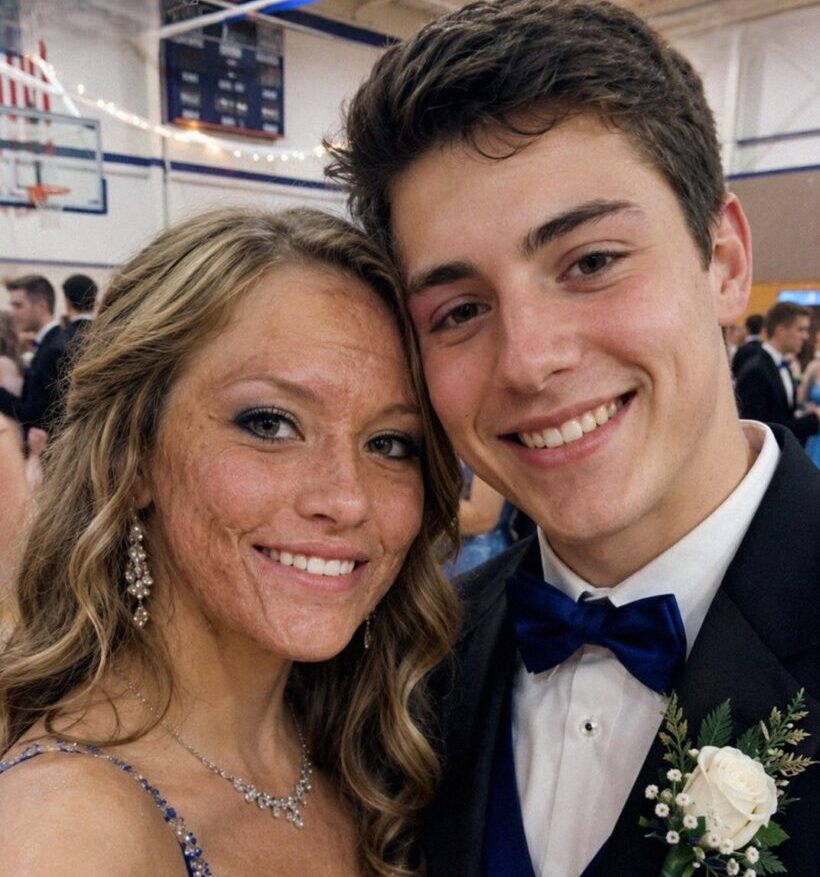
I thought the hardest part of surviving the fire was learning how to live with the scars.
I was wrong.
The hardest part was discovering, years later, that the night that changed my life had never been the accident everyone told me it was.
I was nine when it happened.
I woke up coughing, trapped in smoke so thick I couldn’t see my own bedroom door. My eyes burned. My throat felt like it was closing. Somewhere above the roar of the fire alarm, I heard my mother screaming my name.
By the time firefighters pulled us out, the kitchen was destroyed, and parts of my face, neck, and arm were burned badly enough to leave marks that never completely faded.
Over time, you get used to your reflection.
Or at least, you learn how not to flinch every time you pass a mirror.
The harder part was growing up with everyone else reacting to it.
At school, most people were careful enough not to say anything cruel out loud. But I noticed the stares. The whispers. The quick glances away when I caught someone looking. The questions people were too polite to ask and too curious to hide.
By senior year, I had become very good at pretending none of it bothered me.
So when prom came around, I told my mom I wasn’t going.
“You can’t hide forever, Cindy,” she said, standing in my bedroom doorway. “One terrible night already changed your life once. Don’t let it keep making decisions for you.”
“I’m not hiding.”
She gave me the look only mothers can give.
“Prom happens once.”
Eventually, she wore me down.
We bought a dress. She curled my hair. I spent nearly an hour doing makeup, carefully softening the scars along my neck, even though I knew nothing could erase them completely.
For a moment, standing in front of the mirror, I almost felt pretty.
Then I walked into prom and regretted everything.
The gym looked beautiful, glowing under strings of lights, music pulsing through the floor, everyone laughing and posing for pictures as if they belonged inside the moment.
I stood near the drinks table, pretending to text people who weren’t texting me.
Almost an hour passed.
I was already planning my escape when Caleb walked over.
Everybody knew Caleb. He was tall, popular, handsome, captain of the football team, the kind of guy girls whispered about in hallways and teachers called “a natural leader.”
Which made it even stranger when he stopped in front of me looking nervous.
Then he held out his hand.
“Would you please dance with me?”
I honestly thought he was joking.
But he wasn’t smiling like it was a joke.
So I took his hand.
The second Caleb led me onto the dance floor, people stared. Girls leaned close to whisper. A few guys looked completely stunned.
Caleb ignored all of them.
We danced again.
Then again.
Somewhere between the first song and the third, I stopped feeling like the girl everyone noticed for the wrong reasons. Caleb made me laugh. He spoke to me normally. He looked at me like I was not something damaged or fragile.
By the end of the night, I didn’t want prom to end.
Afterward, Caleb walked me home instead of leaving with his friends.
“You had fun tonight?” he asked.
“Yeah,” I admitted. “More than I expected.”
He smiled, but something about his face looked distracted, almost troubled.
When we reached my porch, we stood awkwardly beneath the yellow light.
“Thanks for tonight,” I said.
He shoved his hands into his pockets. “I’ll see you.”
Then he walked away.
The next morning, loud banging shook the front door.
I came downstairs half asleep and froze when I saw my mother speaking to two police officers.
Beside them stood Caleb’s parents.
Everyone turned toward me.
A knot formed in my stomach.
One officer stepped forward. “Cindy, when was the last time you saw Caleb?”
“Last night,” I said slowly. “After prom. He walked me home.”
“Did he say where he was going afterward?”
“No. Why? Did something happen?”
The officers exchanged a look.
Then one of them asked a question that made my stomach drop.
“Do you really not know what Caleb has done?”
I stared at him. “What?”
The officer spoke carefully.
“Our department recently reopened several old reports connected to unresolved incidents from years ago. During that process, Caleb admitted he was near your house the night of the fire.”
For a second, the words didn’t make sense.
“What do you mean he was there?”
“He witnessed something connected to your house fire when he was nine years old.”
My mother’s face went pale.
“What kind of something?” I asked.
Before the officer could answer, Caleb’s father spoke, his voice tight and desperate.
“He never meant for any of this to happen.”
The officer explained that Caleb’s older brother, Mason, had gotten into trouble constantly as a teenager. The night of my fire, Caleb had secretly followed him on his bike and saw Mason coming out of my house shortly before the fire started.
Recently, Caleb had finally told his parents part of what he saw because Mason was about to be released after serving time for a different crime.
But that morning, Caleb was gone.
His truck was missing.
He wasn’t answering his phone.
After hearing from another parent that Caleb had spent prom night with me, his parents came to ask if I knew where he might be.
I told them I didn’t.
Technically, that was true.
But after everyone left, I couldn’t stop thinking about the place where Caleb and the football guys always went when they wanted to disappear.
The abandoned buildings near the edge of town.
So I lied to my mother and said I needed fresh air.
Then I grabbed my backpack and took the bus.
Because for the first time since the fire, the truth felt close enough to touch.
And I needed to hear it from Caleb himself.
The old factory site was three blocks from the bus stop. Broken windows. Graffiti. Empty lots. The kind of place teenagers went when they didn’t want adults asking questions.
I spotted a group of football players near one of the buildings.
The second they saw me, their conversation stopped.
A few exchanged looks. One laughed under his breath.
I ignored them and kept walking.
“Have any of you seen Caleb?” I asked.
Nobody answered.
Then one boy leaned back against the wall and smirked. “Why? Are you his girlfriend now?”
A couple of them laughed.
I should have turned around.
Instead, I lifted my chin.
“I just need to talk to him.”
Most of them looked away. Finally, Drew, another player, sighed.
“He might be at Taylor’s place.”
The others glared at him.
“What?” Drew said. “We all know they’re secretly dating.”
That caught me off guard.
“Taylor with the piercings?” I asked.
He nodded. “Her parents are out of town.”
Twenty minutes later, I stood outside a small blue house and knocked.
Taylor answered in an oversized sweatshirt, her eyes widening when she saw me.
“Cindy?”
“I’m sorry for showing up,” I said quickly, “but the police and Caleb’s parents came to my house this morning looking for him.”
The moment I said Caleb’s name, her expression changed.
Then footsteps sounded behind her.
Caleb appeared in the doorway, exhausted and pale, like he hadn’t slept at all.
“Cindy…”
I folded my arms tightly.
“You were there the night of the fire?”
For a moment, nobody spoke.
Then Caleb stepped outside.
“Yeah,” he admitted.
Hearing him say it out loud made my stomach twist.
“What happened?”
He looked down.
“When I was nine, I saw Mason sneak out late. He used to do stuff like that all the time. I followed him on my bike because I thought it was a game.”
His voice shook.
“I lost sight of him for a while. Then I saw him climbing out of a window at your house. A few minutes later, smoke started coming from the kitchen.”
I stared at him.
“I got scared and rode home. The next morning, when everyone started talking about the fire and what happened to you…” He swallowed hard. “I kept thinking if I told anyone, Mason’s life would be over.”
“So you stayed quiet?”
His face crumpled.
“I was nine.”
That stopped me.
Because he had been.
He had been nine. A scared child protecting an older brother he didn’t understand yet.
Caleb explained that Mason kept getting into trouble as he got older. Fights. Juvenile detention. Eventually, prison. But Caleb never stopped thinking about that night.
Especially once we ended up at the same school.
“At first, I avoided you,” he said. “Every time I looked at you, I thought about the fire.”
But avoiding me had become impossible. Classes. Hallways. Football games. Group projects. And somewhere along the way, guilt became something messier, quieter, and more painful.
Then he told me something I hadn’t expected.
Before prom, he overheard some guys joking that nobody would ask me to dance.
“I snapped,” he said. “One of them almost punched me over it.”
Taylor stood silently behind him.
Caleb looked straight at me.
“I didn’t ask you to dance because I felt sorry for you. I did it because I was tired of pretending I didn’t care about you.”
For a moment, I forgot how to speak.
Then I asked the question that still mattered most.
“Why would Mason do something like that?”
Caleb shook his head.
“I don’t know.”
Then his expression shifted.
“But maybe it’s time we asked him.”
An hour later, Caleb drove us to the correctional facility two towns over. Taylor stayed in the car while Caleb and I went inside for visitation.
The whole drive, my stomach stayed in knots.
Part of me expected Mason to look terrifying.
Instead, when he walked into the room, he looked tired, older than he should have, and already ashamed.
The second he saw me beside Caleb, his face fell.
Nobody spoke at first.
Then I leaned forward.
“Why did you do it?”
Mason stared at the table.
“It wasn’t intentional,” he said quietly. “I was fourteen. I used to sneak around neighborhoods at night doing stupid things. That night, I saw the garden gnome outside your house and walked over. Then I noticed the kitchen window was cracked open.”
Caleb sat frozen beside me.
“I climbed inside because I thought I could steal something small and nobody would know. While I was in the kitchen, I lit a cigarette. After a few minutes, I left it on the counter while I looked through the living room.”
I felt sick.
“Then I heard movement and panicked,” Mason continued. “I climbed out the window and ran.”
Caleb stared at him. “You didn’t mean to start the fire?”
Mason looked genuinely confused and horrified.
“I didn’t even know there was a fire until the next morning.”
For years, Caleb had believed his brother intentionally burned my house down.
You could see that belief breaking inside him.
Mason looked at me again.
“I’m sorry, Cindy. For all of it.”
Silence settled between us.
Then he added, “If you want to report it now, I understand.”
I looked at him for a long time.
I expected rage.
I expected the kind of anger that burns clean through everything.
But mostly, I felt sad.
Sad that one reckless teenage decision had changed so many lives.
Sad that my mother had spent years blaming faulty wiring.
Sad that Caleb had carried guilt for almost a decade over something he barely understood as a child.
When Caleb and I left, we didn’t speak much during the drive back.
But before going home, we stopped at the police station.
I told the officers everything Mason had admitted.
When they asked whether I wanted to move forward with charges, I thought of my scars. My mother screaming my name. Caleb at nine years old, pedaling home in terror. Mason sitting across from me, ruined by a mistake he could never undo.
Then I shook my head.
“No,” I said. “I don’t. And I’m sure my mother won’t either.”
Because charges would not erase the scars.
They would not give me back the girl I had been before the fire.
They would not undo the years I spent shrinking beneath other people’s stares.
But walking into that police station did give me something.
The truth.
And for the first time in years, I understood that my scars were part of me, but they were not the whole story.
The fire had changed my life.
But it did not get to own it anymore.