The prosecutor slowly unfolded the drawing.
The courtroom leaned in.
At first glance, it looked like the kind of picture any three-year-old might draw. Uneven stick figures. Oversized circles for heads. Bright colors where colors didn’t belong.
Then he saw it.
Near the overturned table Nora had drawn a small red shape.
Not just a red shape.
A red mug.
With a blue star on the side.
The prosecutor’s eyes widened.
Detectives had found a shattered coffee mug beneath the kitchen cabinets the night of the assault.
It had been knocked behind a trash can during the struggle.
The detail had never appeared in any news report.
The jury had never heard about it.
In fact, only investigators and crime scene technicians knew it existed.
The prosecutor carefully turned to the judge.
“Your Honor, this drawing contains details that were never released publicly.”
The defense attorney objected immediately.
But his voice sounded weaker now.
The judge examined the picture himself.
Then looked at Nora.
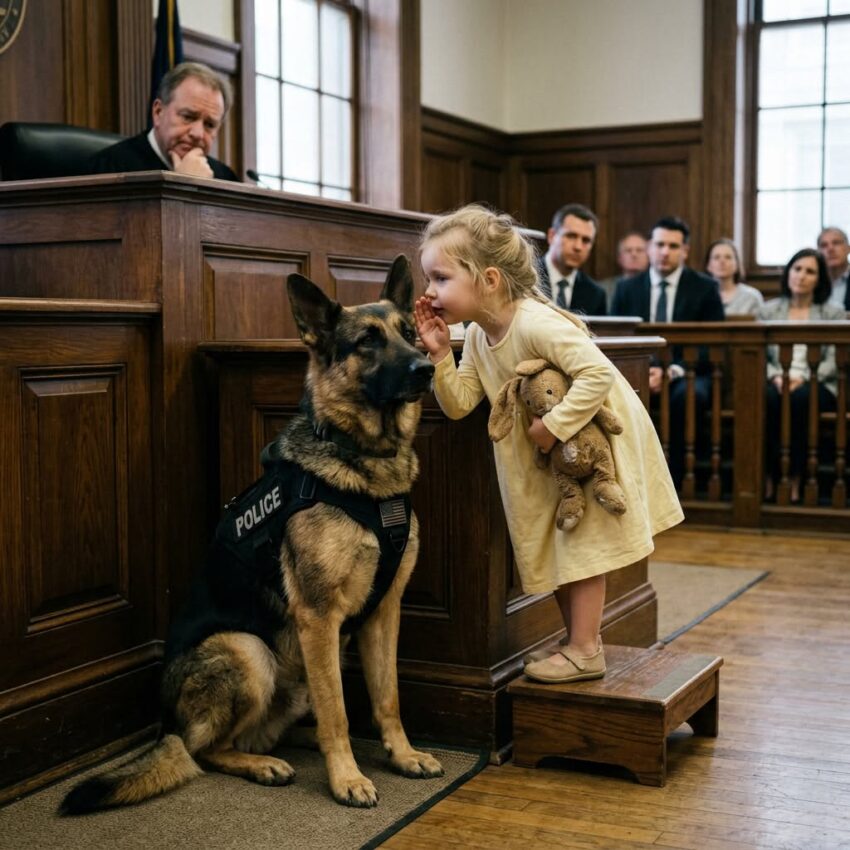
“Nora,” he said gently, “can you tell us about the red cup?”
Nora’s fingers tightened around Atlas’s fur.
For a moment everyone feared she would retreat back into silence.
Then she whispered.
“Mommy’s cup.”
The room became still again.
“What happened to Mommy’s cup?” the judge asked.
Nora looked down.
“He threw it.”
The defendant shifted in his seat.
For the first time that morning, he looked nervous.
The prosecutor knelt so he wouldn’t tower over her.
“Who threw it?”
Nora’s eyes slowly moved toward the defense table.
Toward the man she’d been avoiding all morning.
The man who had once lived in her apartment.
The man who now couldn’t meet her gaze.
“Him.”
A murmur spread through the gallery.
The judge immediately called for order.
But the atmosphere had changed.
This was no longer a case built entirely on physical evidence.
Now there was a witness.
A frightened, fragile witness.
But a witness nonetheless.
The prosecutor asked no more questions.
Instead, he thanked Nora.
Then something unexpected happened.
Atlas gently rested his head on her lap.
The little girl smiled.
It was the first smile anyone in that courtroom had seen from her.
And somehow it felt more powerful than any testimony.
Over the next two days, investigators presented additional evidence.
Photographs.
Medical reports.
Phone records.
Witness statements from neighbors who had heard shouting before the attack.
Piece by piece, the story became clearer.
The defense tried to argue that Nora was confused.
That she was too young.
That her memory couldn’t be trusted.
But the drawing remained.
The red mug.
The hidden detail.
The thing no one could explain away.
When the verdict finally arrived, the courtroom was packed.
Nora wasn’t there.
Her foster mother had taken her to a nearby park instead.
She deserved swings and sunshine, not another day in court.
The jury deliberated for less than four hours.
Guilty.
The defendant lowered his head.
Several people in the gallery cried quietly.
Justice didn’t erase what had happened.
It never could.
But it mattered.
Months later, Nora’s mother had recovered enough to leave the rehabilitation center.
The reunion was arranged carefully.
No reporters.
No cameras.
Just a quiet room at a family services office.
Nora sat on the floor holding her stuffed rabbit.
When the door opened and her mother entered, neither moved at first.
Both seemed afraid the moment might disappear.
Then Nora stood.
“Mommy?”
Her voice was small.
But clear.
Her mother burst into tears.
The next second they were wrapped in each other’s arms.
Everyone in the room looked away, giving them privacy.
Even Atlas’s handler wiped his eyes.
A year later, Nora was living with her mother again.
She was talking more.
Laughing more.
Sleeping through most nights.
The nightmares hadn’t vanished completely.
Some scars take time.
But she was healing.
One spring afternoon, a local community event honored first responders, service animals, and families who had overcome extraordinary hardships.
Nora and her mother attended.
So did Atlas.
The moment she saw him, Nora ran across the grass and threw her arms around his neck.
Atlas sat patiently, tail thumping against the ground.
“Remember him?” her mother asked.
Nora nodded.
“He listened.”
Her mother smiled.
“Yes.”
Nora looked into the dog’s eyes.
“He was the first one who wasn’t scary.”
For a moment, nobody spoke.
Then Atlas licked her cheek, making her giggle.
And that sound—bright, carefree, completely unafraid—was the happiest ending anyone who had been in that courtroom could have imagined.