The Rain That Brought Riders to Maribel’s Porch
The storm came in quietly at first.
Out beyond the wide roads near Abilene, Texas, the late-summer sky turned from pale blue to a heavy shade of gray. The air smelled like dry grass, warm dust, and rain that had not yet touched the ground.
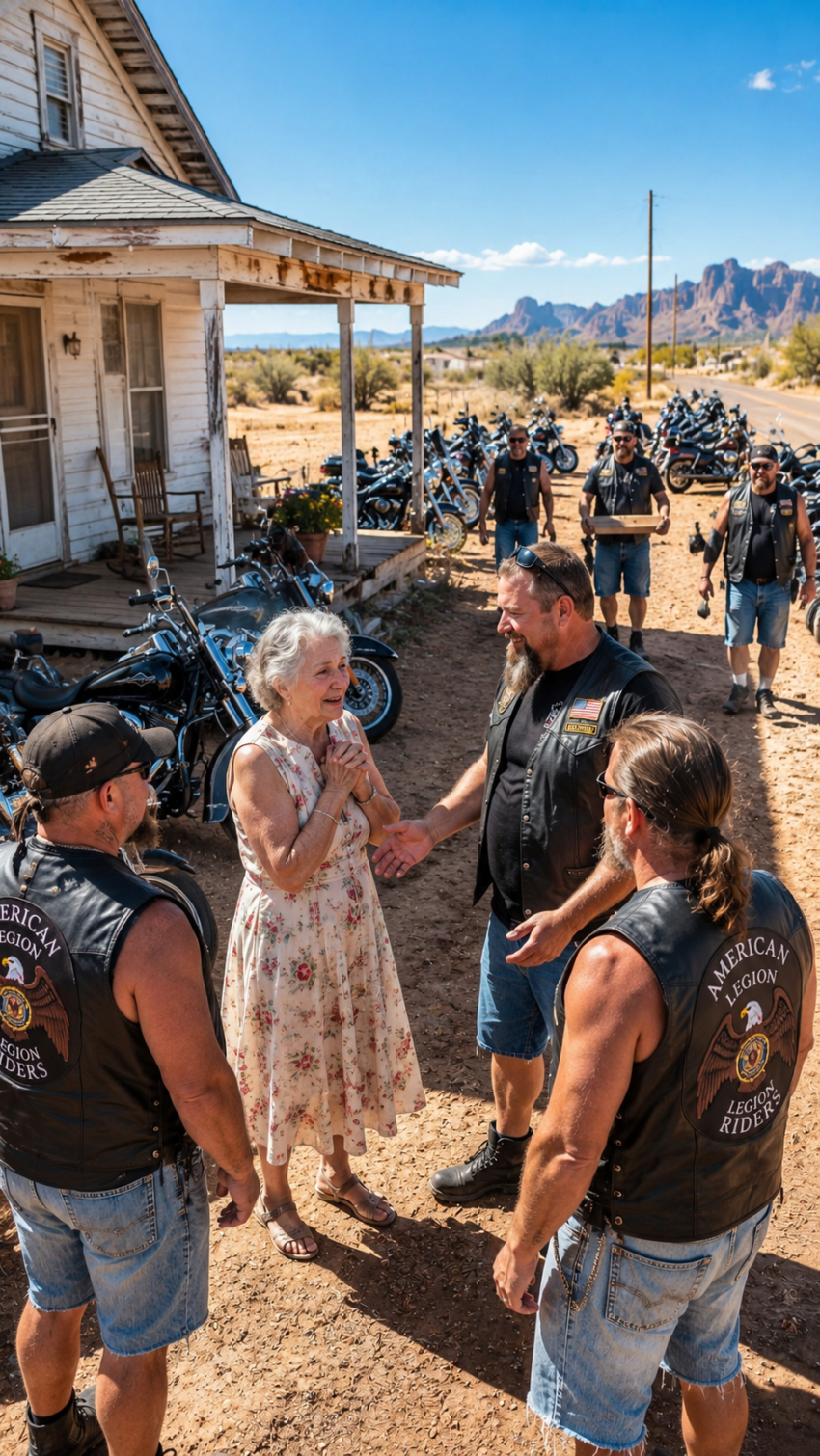
Maribel Lawson stood on the front porch of her old farmhouse with one hand resting on the wooden rail.
At seventy-four, she had learned to read the weather better than most people read the morning paper. She knew when the wind shifted. She knew when the birds disappeared. She knew when the clouds were no longer just clouds.
A storm was coming.
Her house stood alone beside a quiet country road, surrounded by open fields and an aging fence that leaned in several places. The white paint on the siding had faded years ago. The porch steps creaked under every footstep. One upstairs window had been patched with cardboard after a branch cracked the glass the previous winter.
Still, it was home.
Her late husband, Walter Lawson, had built most of it with his own hands. He had not been a rich man, but he had known how to make things last. He used to say a home did not need to be perfect to be full of love.
Walter had been gone for eleven years.
Since then, the rooms had grown too quiet.
Their only daughter lived in Colorado with a busy job, two teenagers, and a life that always seemed too full for long visits. Calls came on holidays, sometimes birthdays, and sometimes not at all.
So Maribel lived simply.
She grew tomatoes behind the house. She baked bread when her hands felt strong enough. She fixed what she could and learned to ignore what she could not afford to repair.
That evening, as the wind pressed against her cardigan, she heard a sound moving across the road.
Not thunder.
Engines.
Thirty Strangers on the Road
Maribel narrowed her eyes and looked toward the long stretch of highway beyond her property.
At first, she saw only dust rising.
Then the motorcycles appeared.
One after another, they came around the bend, chrome flashing under the darkening sky. There were dozens of them, riding in a steady line, leather jackets snapping in the wind.
Most people would have stepped inside and locked the door.
Maribel did not move.
She had lived long enough to know that fear often dressed itself as judgment.
The first rider slowed near her mailbox. He was a tall man, maybe in his late fifties, with a gray beard, tired eyes, and a respectful way of moving. He parked at the edge of her gravel drive, removed his helmet, and walked toward the porch without stepping too close.
“Ma’am, I’m sorry to trouble you,” he said. “That storm is coming faster than we expected. Is there any place nearby where a group could wait until it passes?”
Maribel looked past him.
More riders had stopped along the road. They stayed beside their motorcycles, quiet and patient, as if they did not want to frighten her.
The sky flashed in the distance.
Rain would be there within minutes.
Maribel turned back to the man.
“How many are with you?”
He hesitated.
“Thirty-two.”
She studied him for one second longer, then nodded toward the side yard.
“Bring the bikes around back. There’s room near the shed. Then come inside before the rain catches you.”
The man blinked as if he had heard her wrong.
“Ma’am, there are thirty-two of us.”
Maribel gave him a small, firm smile.
“Then we’ll make room for thirty-two.”
A Small House Full of Warmth
The rain arrived before the last motorcycle was parked.
It fell hard and fast, turning the dusty yard dark within seconds. Thunder rolled across the fields, and wind pushed sheets of water against the windows.
Inside, Maribel moved through her kitchen with purpose.
She opened the pantry and took inventory.
A bag of rice.
Two cans of beans.
A few jars of sauce.
Onions, peppers, and tomatoes from her garden.
Half a loaf of bread.
It was not much, but Maribel had spent a lifetime making little things stretch.
The riders entered one by one, removing wet jackets, wiping their boots, and thanking her in low voices. They were large men and women, rough around the edges, with road-worn faces and heavy boots. But they treated her home with care.
The man who had spoken first stood near the kitchen doorway.
“My name is Nolan Briggs,” he said. “People call me Brick. We appreciate this more than you know.”
Maribel pointed toward the sink.
“Appreciation is nice, Mr. Briggs, but useful hands are better. Can any of you cook?”
A younger woman with dark hair tied under a bandana stepped forward.
“I can chop vegetables.”
“Good,” Maribel said, handing her a knife. “Start with the onions.”
Within minutes, the little farmhouse changed.
One rider stirred the pot.
Another set the table.
Someone found extra chairs in the back room.
A man with a toolbox offered to tighten the loose hinge on the pantry door. Another noticed the dripping faucet and repaired it before Maribel could protest.
The house that had been silent for years suddenly carried voices, footsteps, laughter, and the smell of food.
Maribel stood at the stove, listening to the storm outside and the life inside.
For the first time in a long while, she did not feel alone.
Supper While the Storm Raged
The meal was simple, but no one complained.
Maribel served rice, beans, vegetables, bread, and hot coffee in every mug she owned. Some riders sat at the table. Others balanced plates on their knees in the living room. A few stood near the hallway because there was nowhere else to sit.
Nolan watched as Maribel filled everyone’s plate before touching her own.
“You should eat too,” he said gently.
She waved him off.
“Guests first.”
“You fed thirty-two strangers with what you had in the pantry.”
“Food tastes better when it’s shared,” she replied.
The room grew quiet for a moment.
Then one of the riders, a broad-shouldered man with kind eyes, lowered his head and said, “My mother used to say that.”
Maribel smiled.
“Then your mother was a smart woman.”
Outside, thunder shook the windows.