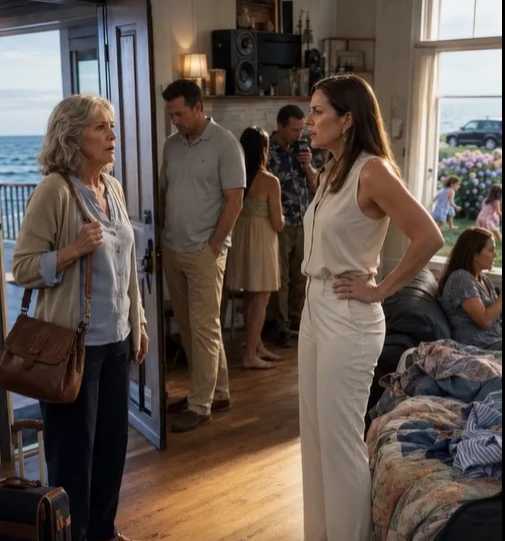
The instant my daughter-in-law looked directly at me inside my own beach house and asked, “Why is she here?” I realized she no longer saw me as part of the family.
In her eyes, I was the visitor.
So I smiled, reached into my purse for my phone, and got ready to make the one call that would erase the future she had already claimed in her imagination.
All I had wanted was a peaceful weekend beside the ocean.
At seventy, I had learned that peace was not something you simply waited to receive. It was something you defended. After my husband Henry passed away, the beach house became the only place where grief released its hold on my
chest. Before sunrise, I would sit on the porch with a cup of tea, listen to the
Atlantic roll heavily across the shore, and imagine for a few quiet minutes that Henry was still inside, repairing the old screen door he had never managed to fix correctly.
That house had not been inherited.
It had not been handed to me by a rich relative.
I purchased it after forty-two years of aching shoulders, swollen hands, and long
nights spent leaning over a sewing machine. I altered wedding gowns for women who never bothered to learn my name. I sewed curtains for houses I could never dream of owning. I saved every spare dollar until Henry and I finally placed our
signatures on the papers for that worn little house beside the sea.
Every curtain inside it belonged to me.
Every quilt.
Every flower garden.
Every crooked nail Henry drove into the walls and later laughed about.
My son Robert once understood that. When he was eight years old, he said the house “smelled like peace.” He would race barefoot down the hallway, leaving trails of sand behind him while Henry pretended to be angry.
But Robert became an adult. His career consumed him. Then Megan entered his life.
And Megan viewed the beach house the way certain people stare at a locked display case filled with jewelry.
At first, she never voiced the cruel thought openly. She described it as “too much space for one person.” She said the staircase was “not practical at my age.” Once, while laughing with her sister over dinner, she said, “Honestly, that place could be amazing with the right updates.”
The right updates.
As though the life I had built was nothing more than an old-fashioned floor plan.
Her relatives began asking unusual questions. How many bedrooms were there? Was the deed completely clear? Had I ever thought about renting the property? Did Robert understand how expensive the property taxes were?
One evening, I walked onto the rear porch and overheard Megan speaking on the phone beside the kitchen window.
“When it belongs to us, the first thing we’re getting rid of is that ugly little sunroom,” she said. “Robert won’t argue with me about it.”
When it belongs to us.
Not if.
When.
The following morning, I contacted an attorney.
I did not tell anyone. Not Robert. Not Megan. Not even my own sister. Quietly, carefully, and legally, I revised my estate plan. The beach house would no longer be left to Robert. Not after my death. Not while Megan stood at the edge of my remaining years with remodeling ideas in one hand and calculated patience in the other.
I continued hoping I would never have to reveal it.
Then I showed up one day earlier than planned.
The driveway was crowded with vehicles I had never seen.
Someone had left a car on the lawn Henry had lovingly cared for over two decades. Children I did not recognize were racing through my gardens, trampling the hydrangeas he had planted after my first operation.
Loud music rattled the windows.
Inside, unfamiliar people had taken over my living room. One man
was drinking from Henry’s old navy mug. Someone had removed my wedding photograph from the mantel to clear a spot for a speaker. Damp towels had been tossed across my handmade quilt as though it were ordinary hotel bedding.
One corner of the quilt was dripping onto the hardwood floor.
I watched a bead of water gather at the lowest stitch, swell, and fall.
Then I pressed the call button.
Megan’s smile disappeared.
“Who are you calling?”
I held the phone against my ear.
“The person I should have called months ago.”
Robert appeared in the doorway leading from the deck.
He was barefoot, holding a bottle of beer, wearing the expression of a man who had just walked into the middle of a conversation he hoped someone else would finish for him.
“Mom?”
I looked at him.
For one terrible second, I saw him at eight years old again.
Sand in his hair.
A missing front tooth.
Henry chasing him down the hallway with a towel.
Then the image vanished.
The man standing in front of me was fifty years old, and he had allowed strangers to occupy my home without asking me.
“You weren’t supposed to be here until tomorrow,” he said.
The words landed harder than Megan’s question.
Not hello.
Not I’m sorry.
Not I should have called.
You weren’t supposed to be here.
Behind him, the ocean thundered against the shore.
I turned slightly so he could see the wet quilt.
“So that is the problem?”
His eyes followed mine.
His shoulders dropped.
“Mom, this isn’t what it looks like.”
Megan gave a sharp laugh.
“Oh, please. It’s a family weekend.”
I looked around the room.
At least twenty people were inside the house.
I recognized three.
“You and I have very different definitions of family.”
A voice answered on the phone.
“Judith?”
Megan went completely still.
She knew that name.
I had mentioned my attorney once at Christmas when discussing a medical directive. Megan had asked three follow-up questions before dessert.
“Yes,” I said. “I’m at the house. I need you to move forward with the documents we discussed.”
Robert set his bottle down.
“What documents?”
I kept my eyes on him.
“All of them.”
Judith’s voice became more alert.
“Are you safe?”
“For the moment.”
“Do you want me to contact local authorities?”
I looked past Robert toward the deck.
A stranger had his shoes on my outdoor table.
Another was leaning against the railing Henry and I had painted together the summer before his heart began failing.
Megan stepped toward me.
“There is absolutely no reason to involve the police.”
I raised one finger.
She stopped.
That surprised both of us.
“Yes,” I told Judith. “I think there is.”
Robert’s face changed.
“Mom.”
“Tell everyone to leave.”
He glanced around the room.
“Right now?”
“Right now.”
Megan folded her arms.
“No.”
The room seemed to contract around that single word.
Even the music suddenly felt too loud.
Someone near the kitchen lowered the volume.
Megan looked directly at me.
“We invited these people for the entire weekend. Some of them drove six hours.”
“That sounds inconvenient.”
Her cheeks reddened.
“You cannot throw everyone out because you arrived a day early and decided to have some kind of emotional reaction.”
My hand tightened around the phone.
For forty-two years, I had worked with fabric.
I knew the difference between something stretched and something torn.
Whatever remained between Megan and me had just torn.
“This is my house.”
“Robert is your son.”
“Yes.”
“He is going to inherit it.”
“No.”
The word came out quietly.
Robert stared at me.
Megan blinked.
Nobody moved.
The screen door behind Robert swung inward with the wind and struck the frame once.
Twice.
Three times.
Megan recovered first.
“What did you say?”
“I said no.”
Robert’s lips parted, but nothing came out.
I continued.
“You will not inherit this house.”
The color drained from Megan’s face so quickly that the transformation was almost frightening.
Robert looked as though I had struck him.
“Mom, what are you talking about?”
“I changed my estate plan months ago.”
Megan’s eyes sharpened.
“Months?”
“Yes.”
“Why?”
I looked at her.
“You know why.”
For the first time since I entered the house, she appeared uncertain.
Only for a moment.
Then she turned toward Robert.
“She’s trying to manipulate you.”
I almost laughed.
Instead, I walked to the mantel, picked up my wedding photograph from where someone had placed it facedown beside a stack of paper plates, and wiped a greasy fingerprint from the glass with my sleeve.
Robert watched me do it.
He looked away first.
Megan stepped closer to him.
“Tell her.”
He frowned.
“Tell her what?”
“That we have a right to be here.”
Robert said nothing.
Megan stared at him.
“Robert.”
I could see the calculation beginning behind her eyes.
The evening she had imagined was collapsing.
The property she had imagined was disappearing with it.
Then the doorbell rang.
No one moved to answer it.
It rang again.
I walked past them and opened the door.
A man in work boots stood on the porch beside a younger woman holding a clipboard.
Behind them was a white contractor’s van.
The man looked at me, then at the crowded driveway.
“Mrs. Bennett?”
I hesitated.
“Yes.”
He smiled and extended his hand.
“Frank Dawson. Coastal Renovation Group. We’re a little early, but with the weather coming Monday, my crew wanted to confirm access before we bring the dumpster.”
The silence behind me became absolute.
I did not take his hand.
“What renovation?”
His smile faded.
“The sunroom conversion.”
I heard Robert inhale.
Slowly, I turned.
Megan did not look surprised.
That was all the answer I needed.
Frank looked from me to her.
“I’ve been dealing with Mrs. Bennett’s daughter-in-law.”
“I am Mrs. Bennett.”
The clipboard lowered.
Megan moved immediately.
“This is just a misunderstanding.”
Frank frowned.
“You signed the owner authorization.”
“No,” I said. “She didn’t.”
Robert turned toward his wife.
“What did you do?”
Megan’s voice became low.
“Not here.”
“Apparently,” I said, “here is exactly where you do everything.”
Frank looked uncomfortable.
“I think I should leave.”
“No.”
My voice stopped him.
“Please show me what you have.”
Megan stepped forward.
“You have no right to show her private documents.”
Frank stared at her.
“She owns the property.”
I watched the moment Megan realized she had said too much.
The younger woman handed me the clipboard.
There was my name.
My address.
A photocopy of my driver’s license.
And beneath a property-owner authorization form was a signature that looked enough like mine to fool a stranger.
But not me.
My hands began to tremble.
Not because I was confused.
Because I recognized the copy of my identification.
It had been stored in a folder inside my desk at Robert’s house after I had stayed with them following my knee surgery.
I had forgotten to retrieve it.
Robert leaned over my shoulder.
His face went gray.
“Megan.”
She looked toward the room full of people.
“Everyone needs to go outside.”
No one moved.
Her sister, a woman named Allison, stood near the kitchen counter holding a glass of wine.
She lowered it carefully.
“Megan, what is this?”
“Nothing.”
Frank took the clipboard back.
“There’s also the financing application.”
Robert looked at him.
“What financing application?”
Megan closed her eyes.
Only for a second.
But that second told me there was more.
Frank cleared his throat.
“The initial deposit was paid, but the larger project financing was still pending verification.”
“How much?” I asked.
“Sixty-eight thousand dollars.”
Someone whispered behind me.
Robert gripped the back of a chair.
“Where did you get sixty-eight thousand dollars?”
“We didn’t get it,” Megan snapped. “It was an application.”
“In my mother’s name?”
Her silence answered him.
My knees suddenly felt unreliable.
I sat down in Henry’s old chair.
The room blurred around the edges.
Robert crouched in front of me.
“Mom.”
I looked at him.
“Did you know?”
“No.”
“Think carefully.”
“I swear to you.”
“Did you give her access to my papers?”
His mouth tightened.
“I gave her the key to your desk drawer when you were recovering because she said she needed your insurance information.”
My eyes closed.
There it was.
Not criminal intention.
Not from him.
Something almost worse.
Carelessness.
Trust placed where it had never been earned.
Megan’s voice cut across the room.
“Stop acting like I stole the house.”
I stood.
“You practiced my signature.”
She said nothing.
“You copied my identification.”
Silence.
“You authorized construction on property you do not own.”
Her jaw tightened.
“The room is falling apart.”
“You applied for financing in my name.”
“It never went through.”
Allison made a small sound.
Not quite a gasp.
Not quite a word.
Megan turned toward her.
“Don’t.”
Allison’s face had changed.
“Megan.”
“I said don’t.”
But Allison was already reaching for her purse.
She pulled out her phone.
“You told me she had transferred the house.”
Robert slowly stood.
“What?”
Megan’s expression became dangerous.
“Allison, shut up.”
Her sister flinched.
Then something in her hardened.
“No.”
She unlocked her phone.
“You told all of us.”
The people in the room were no longer guests.
They were witnesses.
Allison scrolled through her messages and held the screen toward Robert.
“She said the deed was being transferred this summer. She said you two were turning the place into a private rental property.”
My stomach dropped.
Robert read silently.
His eyes moved down the screen.
Then up.
“What money?”
No one answered.
He looked at Allison.
“What money?”
Allison swallowed.
“The deposits.”
A man near the fireplace slowly put Henry’s navy mug on the table.
“What deposits?”
Allison’s eyes filled with tears.
“She charged some of us for the weekend.”
Megan laughed once.
A brittle sound.
“It was to cover food.”
Allison shook her head.
“She charged us twenty-five hundred dollars per family.”
The room erupted.
Questions.
Voices.
Disbelief.
I heard almost none of it.
I was looking at Megan.
She stood in the middle of my living room surrounded by the physical evidence of a future she had been selling before I was dead.
My house.
My rooms.
My ocean view.
My husband’s garden.
She had turned my absence into inventory.
Robert stared at her as though seeing a stranger.
“How many people paid you?”
Megan said nothing.
“Allison?”
“Six families that I know about.”
Fifteen thousand dollars.
Perhaps more.
Robert backed away from his wife.
Megan reached for him.
He moved his arm before she could touch him.
That small movement changed everything.
Her face crumpled for half a second.
Then rage replaced it.
“You think I did this alone?”
Robert froze.
I felt the room become quiet again.
Megan pointed at him.
“You complained about her constantly.”
His face went white.
“You said she was sitting on a fortune.”
“I never told you to steal from her.”
“You said this house would solve everything.”
“What everything?”
Megan laughed through clenched teeth.
“Our debt, Robert.”
He stopped breathing.
I saw it.
Actually saw the moment his chest stopped moving.
“What debt?”
Megan’s eyes shifted.
Too late.
He stepped toward her.
“What debt?”
She whispered the number.
I did not hear it.
Robert did.
His hand went to his mouth.
“How much?”
“Just under one hundred and ninety thousand.”
Allison sat down.
Robert looked as though the floor had disappeared beneath him.
“How?”
“Cards. Loans. The business investment.”
“You told me that account was closed.”
“I was fixing it.”
“With my mother’s house?”
“I was trying to save us.”
“No.”
His voice broke.
He looked around at the strangers.
At the towels.
At the contractor.
At me.
“No. You were trying to save yourself.”
Megan began crying then.
But I had lived long enough to know tears did not always arrive with remorse.
Sometimes they arrived when consequences finally did.
Blue lights flashed through the front windows.
Someone had called the police.
Judith arrived ten minutes later.
She entered carrying a leather folder and wearing the calm expression of a woman who had spent thirty years watching people discover that paperwork could speak more loudly than anger.
She sat beside me.
The officers separated everyone.
Statements were taken.
Phones were shown.
Documents were photographed.
The guests left one family at a time, some embarrassed, some furious, some refusing to look at me.
Before Allison left, she stood in front of me.
“I’m sorry.”
I studied her face.
She looked genuinely ashamed.
“You believed what you wanted to believe.”
Her eyes lowered.
“Yes.”
“That is how people like Megan get away with things.”
She nodded.
Then she did something unexpected.
She walked to the couch, gathered the wet towels, folded my quilt carefully over her arms, and carried both toward the laundry room.
She stopped beside Megan.
“I’ll send the messages to the police.”
Megan stared at her.
“You’re my sister.”
Allison’s eyes filled again.
“That is why I should have stopped believing you sooner.”
She left without another word.
By midnight, the house was empty except for Robert, Judith, two officers, and me.
Megan had been taken away for questioning after investigators confirmed enough irregularities in the financing application to require a formal investigation.
No dramatic handcuffs.
No screaming.
No cinematic last threat.
Just the quiet sound of the police car door closing.
Some endings begin that way.
Not with thunder.
With a click.
Robert stood in the kitchen staring at the floor.
“I should go.”
“Yes.”
He flinched.
I had never spoken to him that way.
I hated that it hurt him.
I hated more that it needed to.
At the door, he turned.
“Mom, I didn’t know.”
“I believe you.”
Relief crossed his face.
Then I continued.
“But you knew enough.”
He stopped.
“You knew she spoke about this house as if I were already gone.”
His eyes dropped.
“You knew she made me uncomfortable.”
“I know.”
“You knew she wanted what I had.”
“I know.”
“And every time staying silent was easier than defending me, you stayed silent.”
He pressed his lips together.
I could see the boy inside him trying desperately to find a place to hide.
There was none.
“I’m sorry.”
“I know.”
His eyes lifted.
“That isn’t enough, is it?”
“No.”
He nodded slowly.
Then he left.
I did not sleep.
At four in the morning, I found myself sitting on the porch.
The sky was black.
The wind had weakened.
The ocean moved in darkness beyond the dunes.
For the first time in years, I did not imagine Henry beside me.
I wished for him so fiercely that my chest hurt.
“I defended it,” I whispered.
The words disappeared into the wind.
Then I began to cry.
Not for the house.
Not even for Megan.
I cried for Robert.
For the child who had once believed this place smelled like peace.
For the man who had forgotten what peace cost.
Three weeks passed before I saw him again.
He came alone.
He looked thinner.
There were gray shadows beneath his eyes.
He stood on the porch holding a toolbox.
“I won’t come inside unless you ask me.”
I stared at him for a long moment.
Then I opened the door wider.
He entered quietly.
The criminal investigation into Megan had expanded.
The forged documents were real.
So were the fraudulent applications.
So were several credit accounts Robert had known nothing about.
She eventually accepted a plea arrangement that required restitution and left her facing years of financial and legal consequences that no apology could erase.
Her marriage to Robert did not survive.
Neither did the future she had imagined inside my house.
But I did not celebrate.
Watching someone fall is less satisfying when they have spent years pulling someone you love down with them.
Robert repaired the garden first.
He replanted three hydrangeas.
Two died.
He returned the following weekend and replaced them without mentioning it.
Then he repaired the scratched floor.
The broken cabinet.
The porch railing.
He never asked about the will.
Not once.
A month later, we sat in the sunroom.
The ugly little sunroom.
Rain tapped softly against the windows.
Robert was removing a section of damaged paneling where moisture had entered behind the wall.
His hammer struck something metal.
He stopped.
“What was that?”
We pulled away the loose board.
Inside the narrow space sat a rusted biscuit tin.
My breath caught.
I recognized it.
Henry used to keep nails in tins exactly like that.
Robert lifted it out.
The lid resisted before finally opening with a squeal.
Inside were three things.
A faded photograph.
A plastic toy boat.
And a folded piece of paper.
Robert picked up the photograph first.
It showed him at eight years old standing between Henry and me on the beach.
He was missing his front tooth.
Sand covered his knees.
On the back, in Henry’s handwriting, were four words.
The day we arrived.
Robert unfolded the paper.
His face changed.
“What?”
He did not answer.
His hands began trembling.
Then he handed it to me.
The handwriting was childish.
Large crooked letters written in blue crayon.
THIS IS MOM’S PEACE HOUSE.
WHEN I GROW UP I WILL MAKE SURE NOBODY EVER MAKES HER LEAVE.
ROBERT.
Underneath, Henry had written one sentence in pencil.
Hold him to it gently, my love. Children sometimes forget the promises their hearts make before the world teaches them to want things.
I sat down.
Robert remained standing.
He stared at the wall.
Then he covered his face with both hands.
The sound that came from him did not sound like a grown man crying.
It sounded like a child discovering he had disappointed someone who could no longer hear him apologize.
I rose slowly.
For months, I had imagined the conversation I deserved.
I had imagined telling him exactly how much he failed me.
But standing there, with his childhood promise between us, I realized he already knew.
So I placed one hand between his shoulders.
He turned.
“Mom.”
I held him.
Not because everything was forgiven.
Not because everything was forgotten.
Because healing and boundaries are not enemies.
Sometimes you need both.
“I forgot,” he whispered.
“I know.”
“I became someone Dad would hate.”
“No.”
He pulled back.
I looked directly at him.
“Your father would hate what you allowed.”
Robert’s face tightened.
“That is not the same as hating you.”
He cried harder.
So did I.
We stood inside the sunroom Megan had wanted to destroy while rain moved across the windows and the ocean waited beyond the dunes.
I did not change my estate plan.
That surprised Robert when I finally told him.
He nodded.
“I understand.”
The house would never belong to him.
Not legally.
Not after my death.
I placed it into a trust instead.
When my life ended, it would become a small retreat for women rebuilding their lives after loss.
Widows.
Women leaving financially controlling homes.
Women who had spent decades caring for everyone else and suddenly needed somewhere quiet enough to hear themselves think.
The sunroom became a sewing room.
Robert built the tables.
Allison, after testifying against her sister and repaying every dollar connected to the weekend, donated the first six new sewing machines.
I almost refused them.
Then I decided redemption should be allowed to cost something.
Judith helped establish the trust.
My sister chose the curtains.
I sewed the cushions myself.
Robert repaired the old screen door.
Badly.
The first time it slammed against the frame, I laughed so suddenly that I frightened myself.
Robert looked up from the porch.
“What?”
I shook my head.
“Nothing.”
But it was not nothing.
The sound was Henry.
Not his ghost.
Not a memory pretending to be alive.
Something better.
A piece of love continuing through imperfect hands.
A year after the party, Robert came to the house for breakfast.
He still knocked.
I hoped he always would.
Not because he was a stranger.
Because respect had become the new shape of our love.
I opened the door.
He held up a paper bag.
“Blueberry muffins.”
“You burned them?”
“Only the bottom six.”
“Your father would be proud.”
We ate on the porch.
The morning was cool.
Hydrangeas bloomed beside the walkway.
The replacements had finally taken root.
Inside, two women staying at the house were laughing over a sewing machine that had somehow threaded itself incorrectly.
A kettle whistled.
The screen door slammed.
Robert winced.
“I’m going to fix that.”
“No.”
He looked at me.
I smiled.
“Leave it.”
The tide was coming in.
Sunlight stretched across the water until the entire horizon seemed stitched with silver.
Robert leaned back in his chair.
For a while, neither of us spoke.
Then he breathed in deeply.
“You know what I remembered?”
“What?”
“The first thing I ever said about this place.”
I looked toward him.
His eyes remained on the ocean.
“It smelled like peace.”
My throat tightened.
“And now?”
He smiled.
“Still does.”
I reached across the small table and placed my hand over his.
Inside the house, laughter rose again.
The curtains moved gently in the open windows.
Somewhere behind us, a needle began moving through fabric in a steady, familiar rhythm.
For most of my life, I had believed a home was something you protected by holding tightly to it.
I had been wrong.
You protected it by deciding what was allowed to live inside it.
Respect.
Memory.
Truth.
Second chances that did not require surrender.
Love strong enough to lock the door when necessary and open it again when someone had finally learned how to knock.
The screen door slammed once more.
Robert laughed.
This time, so did I.
And beyond the porch, the Atlantic continued rolling toward the shore, endless and patient, carrying away everything that no longer belonged while leaving the house, at last, exactly as Henry and I had always meant it to be.
Full of peace.